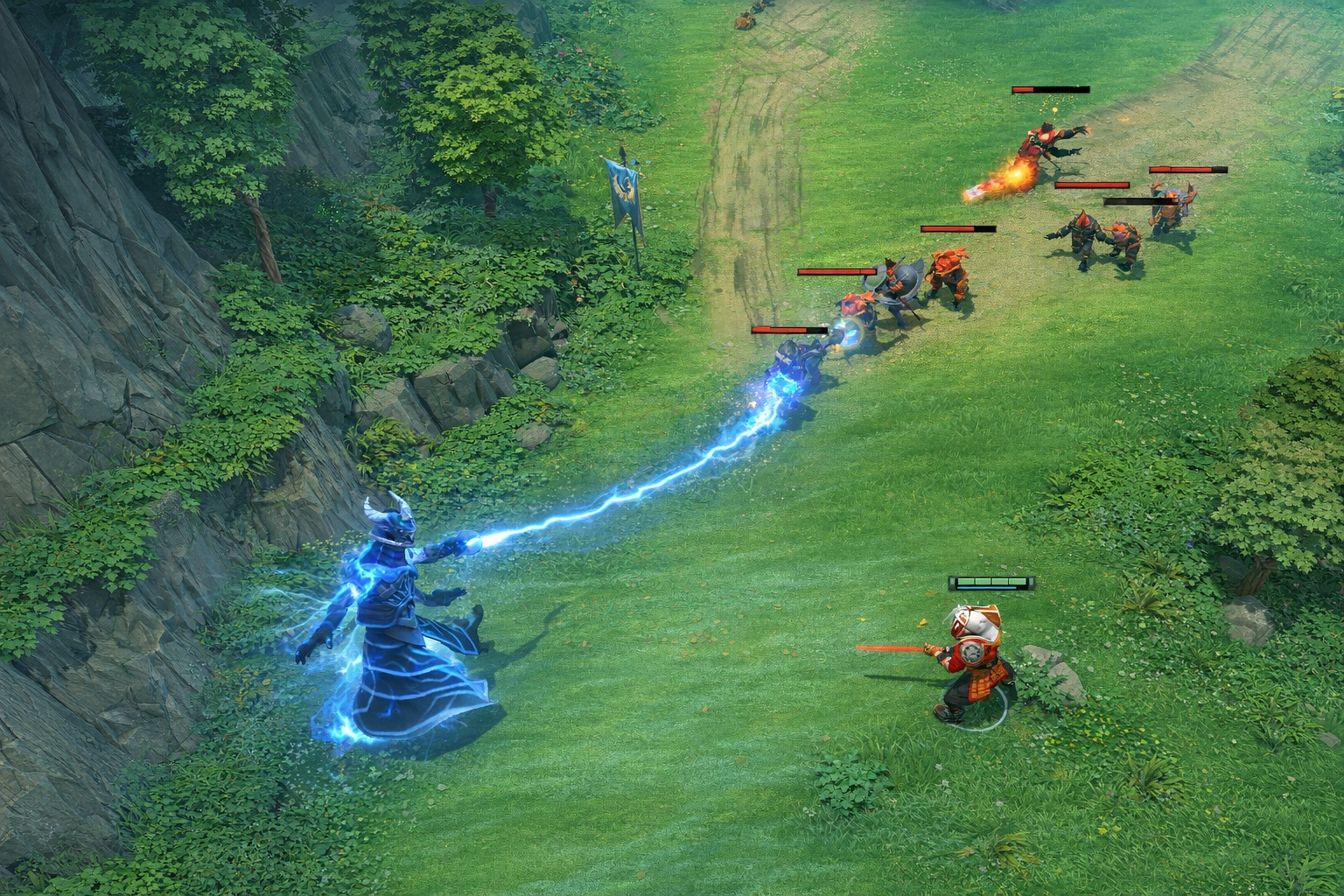
You know this lane. The wave is wobbling in front of the enemy tower, the banner creep is dropping, your support has already wandered off to do something morally questionable near mid, and your camera is flicking between last hits, deny timing, and the carry stepping up for a trade. You get the broad call right. Hold the lane, protect your HP, don’t feed, hit your item timing. Then you still miss the banner, tank two extra tower shots, and walk away feeling like you understood the lane better than the other guy while somehow playing it worse.
That feeling sits right in the middle of one of Dota’s oldest arguments: how far can game sense carry you when your hands lag behind your head? The answer is farther than a lot of players admit, especially in offlane and support. It also has a ceiling, and that ceiling starts showing up hard once every missed input turns a good read into a lost edge.
Macro Wins Games Until Micro Starts Taxing Every Decision
Dota has always rewarded the player who reads the map, understands timing windows, and knows where pressure belongs. If you survive bad lanes, choose fights around objectives, understand when your lineup actually wants to smoke, and consistently move into profitable dangerous farm, you already have skills that decide more ranked games than flashy button pressing ever will.
That matters even more from the offlane. The role is full of ugly games. Your lane can be unsupported. Your matchup can be miserable. Your job can shift from dominating lane to simply staying alive long enough to become the team’s front line and map anchor. A player who knows how to drag the game into a playable state is worth a lot more than a lane artist who wins early and then feeds away every timing because they have no sense of map pressure.
The problem is that macro skill doesn’t exist in a vacuum. Every strategic idea has to cash out through actions. You can know the lane should stay in a certain place, then fail the aggro timing and take bad trades. You can understand that your team wins the next fight if you land first contact, then press your utility in a panic and blunt your own impact. You can read where enemy heroes are likely playing and still lose the game because your farm speed is a little too slow and your item arrives one minute late.
That’s the tax. Poor mechanics don’t erase good decisions. They shave value off every one of them.
The Offlane Lets You Get Away With More Than Mid or Carry
Role matters here. A lot.
If you play carry or mid, mechanics are your income. Last hitting, spell efficiency, farming patterns, wave manipulation, fast camera movement, target selection, and clean use of defensive buttons all directly convert into gold and map control. You can be a genius on those roles and still lose because your net worth is short by one item when the game breaks open.
Offlane gives you more room to compensate. Aura builders, initiators, anti-carry lane bullies, and map-shaping frontliners can create enormous value through movement, itemization, lane survival, and objective calls. When your job is to stand on an area of the map and make it hostile for the enemy carry, that comes from understanding pressure and matchup logic as much as raw execution.
Support can lean even farther in that direction. Good warding, protecting waves, reading smokes, linking up around power spikes, and knowing which core gets to play which area can carry games from positions four and five even if your hands aren’t pristine. You still need competence. You just don’t need carry-level throughput.
That doesn’t mean offlane is a retirement home for mechanics. It means the role is forgiving enough that your strengths can still dominate the game flow. If you’re already Divine on offlane with shaky execution, that’s proof the macro side is doing real work.
The Mechanical Mistakes That Actually Matter
Some mechanical flaws are ugly but survivable. Others bleed too much value over time.
Last hitting is an economy problem, not a cosmetic one
Missing creeps in lane hurts every role, but it hits offlane in a specific way. Your hero pool often wants one key item to unlock the next phase of the game. Blink on initiators. Auras on frontliners. Durable stat items on heroes who need to stand their ground. When your CS is unreliable, your timing drifts. That changes whether you invade triangle on schedule, whether you can force a tower, whether the enemy carry gets one more peaceful wave before you become a problem.
The banner creep is the perfect example because it concentrates the issue. Missing one feels bad. Missing it regularly means your lane economy is leaking in one of the most stable places you should be collecting value.
This is one of the easiest mechanical holes to improve because it responds well to repetition. Pure last-hit drills still work. So does spending a couple minutes before queue just practicing under tower and contested ranged creep timing on the actual heroes you spam. Dota mechanics are often less about talent than about removing hesitation.
Creep aggro is lane control in one input
Good aggro usage makes hard lanes playable and playable lanes oppressive. It lets you reposition the wave, secure ranged creeps, and drag enemy heroes into awkward spots when they try to punish you. Bad aggro turns into a sequence every offlaner knows: failed click, extra right-clicks taken, wave moving the wrong way, then a scramble to recover.
This is also one of the most misunderstood mechanics because players treat it like a vague habit instead of a deliberate tool. The point isn’t to spam it whenever the lane feels bad. The point is to use it with a reason. Secure a specific creep. Pull the wave off the enemy support. Shift equilibrium by a small amount. If you’re clicking until it works, you’re already paying too much attention for too little return.
Once your lane logic is strong, aggro becomes easier because the decision tree shrinks. You stop asking “can I aggro here?” and start asking “which creep do I want, and where do I want the wave after this?”
Tower aggro management separates pressure from self-harm
A lot of players lose HP under enemy tower for no real reason. They go for harass and CS in the same sequence, draw tower aggro at the wrong moment, and turn what should have been clean pressure into a self-inflicted reset. That matters more in offlane than people admit because your HP pool is part of your lane leverage. If you’re constantly chipped down by avoidable tower hits, you give up the freedom to posture aggressively on the next wave.
This is less flashy than landing a spear or microing summons, but it wins more MMR than highlight mechanics. A frontliner who preserves HP and keeps the lane ugly for the enemy carry is doing the role correctly.
Teamfight processing is where age, hardware, and habits all show up
Chaotic fights are where many experienced players feel their mechanics slipping. You know the order of threats in theory. You understand which enemy spell matters. Then the fight starts, screen clutter explodes, and your greaves or lotus comes out on instinct instead of timing.
That’s not always a hands issue. It can be a recognition issue. It can be camera discipline. It can be visual overload from effects and bad positioning. It can also be hardware. Input delay, poor frame pacing, and low refresh feel especially brutal in late-game Dota because the game asks you to parse overlapping animations, spell effects, repositioning, and buyback decisions in seconds.
If your smaller skirmishes are much cleaner than your full 5v5 execution, that’s a useful clue. Your understanding is there. Your processing pipeline gets overloaded. The fix is part setup, part simplification. Better visual settings can help. So can hero choice. So can entering fights with one clear rule such as holding dispel for the first hard commitment instead of trying to answer every particle effect on screen.
Hero Choice Should Respect Your Hands
A lot of players sabotage themselves by choosing heroes that demand the exact skills they lack.
There’s nothing noble about forcing Mars if your lane mechanics are already inconsistent and your farm speed falls off a cliff when the early game goes badly. That hero often needs a decent start and clean execution to feel great. When the lane goes sideways, you can end up poor, mana-starved, and weirdly harmless.
Beastmaster, Visage, Elder Titan, and other higher-bandwidth offlaners ask for different kinds of precision. Some need controlled micro. Some need cleaner spell setup. Some need stronger lane handling because their whole midgame depends on getting to a specific item state fast enough. You can learn them, but you should learn them one at a time and with the understanding that every hero taxes a different mechanic.
Straightforward does not mean low impact. Underlord, Tidehunter, Necrophos, Bristleback, Slardar, and Razor can all ruin games when piloted by someone who understands map pressure and timing. Simpler input demand often frees up attention for what you already do well: reading where action should happen before it happens.
There’s also a hidden edge here. Heroes with lower execution burden let you spend more brainpower on enemy positioning, smoke paths, wave state, and objective setup. That’s a real advantage. Dota punishes overloaded attention more than it punishes lack of flair.
How Much Can You Climb Without Fixing It?
Plenty. Then less than you want.
You can absolutely climb into Immortal with stronger-than-average macro and only decent mechanics, especially from offlane or support. The threshold for entry into Immortal is not “plays every fight like a pro.” It’s “consistently generates more game-winning value than your counterpart.” A player who manages lane disasters, understands map occupation, itemizes correctly, and forces useful reactions can do that over a large sample.
The barrier shows up when your mechanical misses stop being occasional and start being structural. If your lane always gives away a few creeps it shouldn’t, your first item is often delayed. If your first item is delayed, your team’s first big move gets softer. If your utility buttons come out without intention in large fights, your most important contribution becomes coin-flippy. At high Divine and low Immortal, those edges decide a lot.
So the real answer is this: mechanics are already limiting your climb if you can feel them in repeated situations. They are not erasing the value of your strengths. They are setting a tax rate on your whole game.
The Good News: Most of These Are Trainable, Not Talent Locked
Players often dump everything under “mechanics” and treat it like some fixed trait. That’s lazy. Missing banner creeps, failing specific stack timings, fumbling aggro, and misusing dispels in visual clutter are separate problems with separate fixes.
Build micro-routines, not grand improvement plans
If your last hitting is weak, drill the first few waves and under-tower situations on your actual hero pool. If your stacks fail, practice only the camps that give you trouble. If teamfight item usage gets muddy, narrow your rule set on each hero. Use greaves after meaningful damage lands. Use lotus for a known threat window. Pre-decide your first spell target before the fight starts.
That kind of training works because it removes ambiguity. Dota mechanics improve fast when the brain stops improvising every input.
Reduce your hero pool when pushing MMR
You don’t need ten offlaners. You need a handful that cover lane pressure, teamfight, tower defense, and one greedier pick for the right drafts. Repetition matters more than theoretical flexibility on ladder. Familiar attack animation, spell range, turn rate feel, and item timing all lower execution cost.
Check your setup before blaming your age
A bad monitor, unstable frames, weak contrast settings, overloaded effects, awkward keybinds, and poor mouse sensitivity all make Dota harder than it needs to be. Plenty of players discover that “getting old” was partly just playing a reaction-heavy game through a muddy visual pipeline.
Keep the parts of your game that already win matches
PMA matters. Risk evaluation matters. Knowing when to occupy dangerous farm matters. Understanding when to block camps, invade resource zones, or rush objective windows matters. Those are not side traits. Those are ranked-winning traits.
A lot of mechanically gifted players never learn them. They hit creeps beautifully, press buttons quickly, and still donate games because they read the map like a tourist.
Should You Switch Roles?
Only if you enjoy another role more, not because you believe offlane is the reason your mechanics feel exposed.
Offlane already fits your strengths. Lane survival, objective-minded movement, map occupation, item timing awareness, and matchup-based itemization are exactly what make good offlaners miserable to play against. Support could also fit if you want a role where game knowledge can carry even more weight. Carry is the opposite direction. Mid can be brutal unless you actively enjoy grinding lane mechanics and faster execution.
If your goal is Immortal, the cleaner route is probably staying offlane, tightening the most expensive mistakes, and choosing heroes that let your map brain breathe. You do not need to become a mechanical monster. You need to stop leaking enough value that your existing advantages can fully cash in.
That’s the real shape of improvement for a lot of experienced Dota players. You’re not rebuilding from scratch. You’re sanding down the mistakes that keep turning winning ideas into merely decent outcomes.