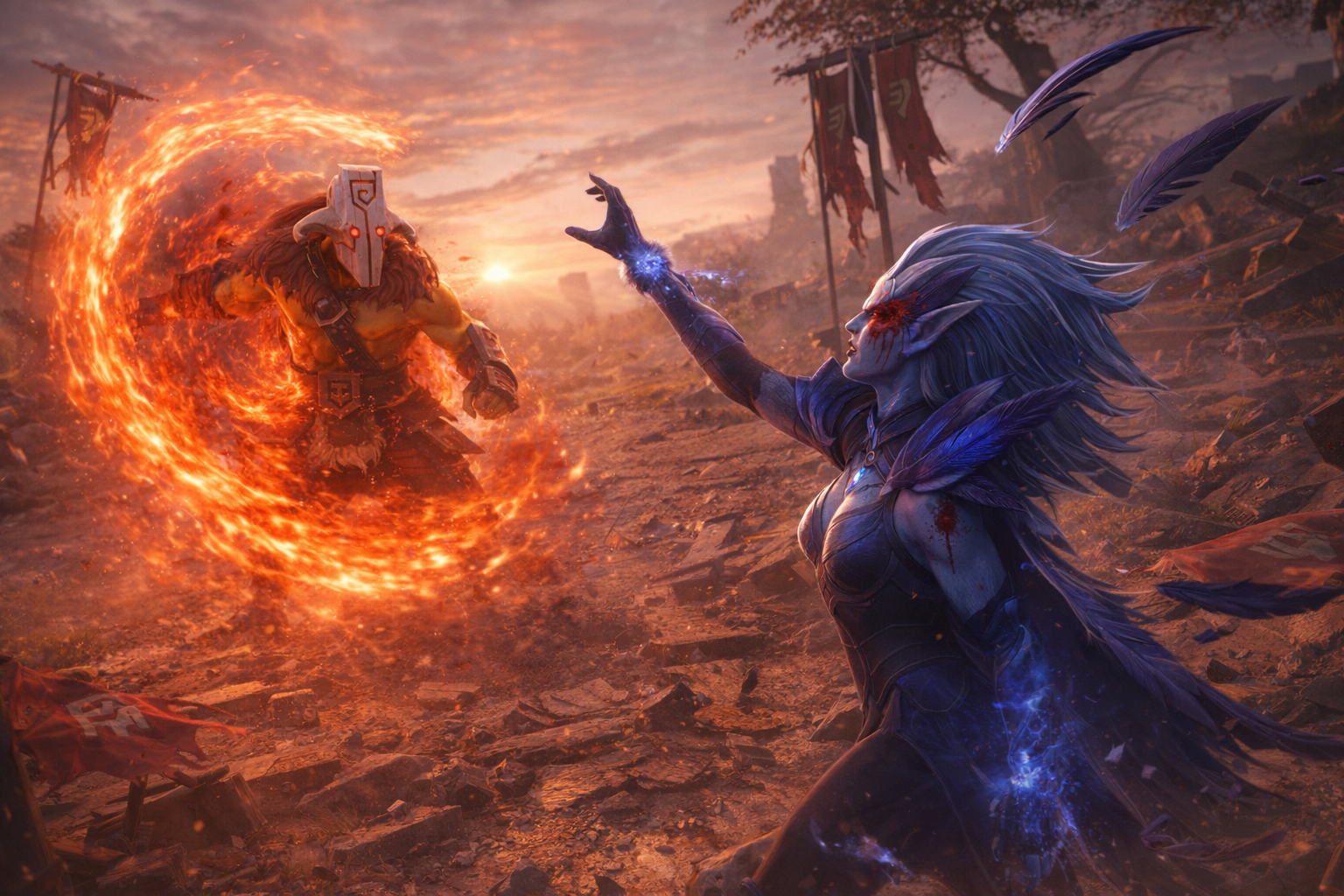
Juggernaut plus a ranged five into your Venge lane. The first wave meets, you walk up for one trade, eat a spin, lose half your health, and suddenly the whole lane feels like you're one bad click away from feeding first blood. Ten minutes later your spells still matter, your swap can still decide the game, and yet the match already feels like it demanded twice as much precision from you as it did from the enemy support.
That gap is the whole Vengeful Spirit story right now. She still has real tools. She still wins fights that other supports can't. She still punishes bad positioning with brutal simplicity. But modern Dota asks early-game supports to cover a lot of jobs at once, and Venge no longer checks enough of those boxes cleanly enough to justify how hard she is to execute.
The hero still does Venge things
Venge remains one of the most conceptually reliable supports in Dota because her kit solves real problems.
Magic Missile gives you straightforward catch. Nether Swap creates saves, punishes overextensions, starts fights from weird angles, and breaks the usual comfort zone of heroes that assume they can stand one step too far forward. Wave of Terror gives vision and armor reduction, which matters more than people admit in scrappy midgame fights around ramps, tormentor areas, and triangle entrances. Her aura also gives her lineup tangible damage value without demanding perfect spell sequencing.
That package always has a floor. A support with instant repositioning will never be irrelevant. In pub games especially, where people drift into dangerous map positions for no reason and hit buildings one hero too far ahead of their team, swap remains one of the cleanest punish buttons in the game.
The problem is that having useful buttons is different from being an attractive pick.
Lane pressure decides who gets picked
The fastest way to understand why Venge vanished from many drafts is simple: her lane asks for too much and forgives too little.
She doesn't bully the lane for free. Her range is short enough that trading often puts her in danger against the support pool that dominates lanes now. Her mana pool makes every spell commitment matter. If you throw a stun for a trade that doesn't convert into a kill, you can feel the cost immediately. Her statline doesn't give her the luxury to absorb a bad approach, walk it off, and reset.
That means Venge lanes are highly intentional. You need to know exactly when you're walking up, exactly who you're threatening, and exactly what your carry can do with the opening. If your partner isn't synced with your stun timing, your lane frequently becomes a series of half-commits where you spend resources and the enemy spends nothing except patience.
Other supports get to create lane advantage with less ceremony. They harass from safer range. They sustain themselves or their core more easily. They clear pulls faster. They threaten kills while also securing ranged creeps or contesting side camps without putting their whole body in danger. Venge can still win lanes, but she does it through cleaner execution rather than raw kit advantage.
That distinction matters a lot in high-MMR pubs and pro play. Drafts lean toward supports that create value even when the lane gets messy. Venge wants a lane with a plan.
The save comes with a body bag
Nether Swap is the reason many players will always keep Venge in their back pocket. It's one of those spells that produces instant clarity. Someone is out of position. Someone is getting jumped. Someone needs to be dragged into a bad place or pulled out of one.
There is also a reason captains and support players hesitate.
Her save often demands that you die.
That trade can absolutely be worth it. Swapping your carry or your mid out of a decisive initiation is good Dota. Turning your own hero into a disposable resource is part of support play. The issue is that modern support design offers a lot of alternatives that preserve allies without immediately donating your own life. Plenty of meta supports save from longer range, save multiple heroes indirectly through control or disengage, or survive their own save sequence more often.
With Venge, the failure case is harsh. You swap someone out, land in the middle of the enemy team, and if your own team isn't ready to counter-engage that play just becomes a delayed death. In coordinated games, every save has a follow-up plan. In pubs, your glorious rescue can strand you beside four enemy heroes while your team finishes farming the nearby wave.
That makes her feel amazing when everyone is on the same page and strangely punishing when they aren't.
The old fantasy got hit
A lot of Venge's recent appeal used to come from the way her later item progression let her stay involved even after sacrificing herself. That gave the hero a very specific identity. You could commit hard, embrace the chaos, and still feel like your game hadn't ended the moment you made the right sacrificial play.
Once that timing got pushed back, a huge slice of her fun and her distinctiveness went with it.
That's a bigger deal than it sounds. Heroes stay popular when they offer either easy value or a compelling fantasy. Venge used to have a very recognizable progression where support play could transition into this annoying, stubborn second life that let you keep influencing fights after the enemy thought they'd cashed your hero in. Now that route feels less like a defining power spike and more like a luxury purchase that belongs much later.
So the hero lost one of the strongest emotional reasons people queued her up in the first place. Even if the win rate remains respectable, players feel the missing payoff.
She gained some useful polish, not a new identity
Venge hasn't been left with nothing. Small buffs and cleaner baseline tools help. Better mobility helps every support. A more practical innate matters. Attack-speed-oriented utility on the hero can make skirmishes and tower pressure feel smoother than people expect.
Those are real gains.
They also don't change the draft question.
When teams pick supports, they usually want one of a few things early: dominant lane control, overwhelming teamfight, reliable wave shove, map mobility, or a save that doesn't turn into a self-execution order. Venge offers bits of several categories without owning one hard enough to push past the competition.
That is the cruelest place for a hero to live in Dota balance. You're viable. You're useful. You're just rarely the cleanest answer.
The support pool got meaner
This part matters as much as any Venge-specific nerf.
Support competition is brutal right now whenever the patch favors heroes that either crush lane, shove dangerous waves, or provide fight impact from safer positions. If another support can win your lane more reliably and still scale into strong utility, that hero steals your draft slot. If a five can secure the lane and defend towers better, Venge gets crowded out. If a four can rotate with less risk and threaten more damage, same story.
Venge's strengths are still recognizable, but they arrive in a support ecosystem where every slot is contested by heroes with sharper specialization. She doesn't feel weak in a vacuum. She feels expensive compared to alternatives.
That shows up most in pro drafts because pros hate paying extra execution tax for comparable results. It shows up in high-level pubs for the same reason. Players gravitate toward supports that salvage awkward lanes, de-push dangerous side lanes, or survive the first contact of a fight more often.
Venge asks you to earn everything.
The wave problem is more serious than it looks
A support can survive a mediocre lane if they solve map problems afterward. Venge often can't do that on her own.
She doesn't naturally clean up shoved lanes with the same comfort as supports built for wave clear. She doesn't erase a dangerous side wave from fog and disappear. She doesn't bail out a map state where your cores refuse to touch lanes and the enemy keeps tightening the net through pressure.
That has huge pub consequences.
You know the game. Your carry wants one more camp. Your offlaner smoked thirty seconds ago and forgot the side wave exists. Mid is farming triangle. One lane is marching into your tower and somebody has to show. Supports with wave tools can patch over that dysfunction. Venge mostly has to walk there, reveal herself, and hope the map doesn't collapse around the attempt.
For pub climbing, that matters more than a lot of highlight-reel spell interactions. If your hero can't independently relieve pressure, your match quality becomes more dependent on teammates doing their maintenance jobs. That's part of why some players feel her power dip as games get cleaner and faster. The higher you climb, the more every missed wave and every delayed item timing gets punished.
Where Venge still shines
There are still very real reasons to pick her.
She is excellent when your draft wants reliable catch without overcomplicating execution. She pairs well with lineups that can instantly capitalize on swap positioning. She becomes much more attractive when the enemy has one hero who absolutely hates being displaced at the wrong second. She also feels good in games where armor reduction and physical burst give your team clean kill thresholds.
Her teamfight contribution is also more stable than people pretend. Vision from Wave of Terror helps on awkward terrain. Swap can break initiation sequences. Stun plus aura still contributes meaningfully in brawls where every support spell gets traded fast.
And in pubs, the simplicity of her punishment pattern stays valuable. Somebody will stand where they shouldn't. Somebody will over-dive a tower. Somebody will channel greed into a terrible position. Venge turns those moments into kills.
When the pick actually makes sense
Pick Venge when your lane partner can follow your commits instead of watching them happen. Pick her when your lineup has enough damage to turn one reposition into a fast numbers advantage. Pick her when the enemy's key hero relies on safe spacing and hates instant displacement.
Avoid forcing her into drafts that already struggle to push lanes out or drafts that need their support to be a self-sufficient map janitor. If your team lacks wave management, Venge will feel like she's playing defense with a knife.
Why her win rate can look fine while her presence disappears
This is the part that confuses a lot of players.
A hero can post healthy results and still vanish from serious attention because pick rate and win rate answer different questions. Win rate asks whether the hero succeeds when chosen. Pick rate asks whether players want the burden that comes with choosing it.
Venge has a profile that can support a decent win rate because her spell kit remains fundamentally useful, and players who willingly pick her often understand what the hero needs. That doesn't make her broadly attractive. The average support player looking at the draft screen sees a lane that can go wrong fast, a save that may require death, weak wave management, and an item path that no longer delivers the same midgame thrill as before.
So the hero becomes specialist territory. A comfort pick. A draft-specific answer. A hero for players who already know where the value lives.
Those heroes rarely dominate visibility even when they are perfectly capable of winning games.
What would bring her back
Venge doesn't need a complete overhaul. She needs one part of her profile to become clearly premium again.
That could be stronger lane security. That could be a more satisfying midgame progression that rewards aggressive support play earlier. That could be better tools for handling map pressure between fights. Any one of those would give players a simple reason to prefer her over neighboring supports.
Until then, she lives in the hardest tier of Dota viability: good enough to succeed, demanding enough to avoid.
If you already love the hero, that isn't a death sentence. It means your edge comes from accepting the burden and playing cleaner than the average support player is willing to. You need sharper lane movement, better spell discipline, and a stronger sense of when a sacrificial swap actually wins the fight instead of decorating the enemy's kill feed.
That version of Venge can still carry games from support. She just doesn't carry drafts anymore.