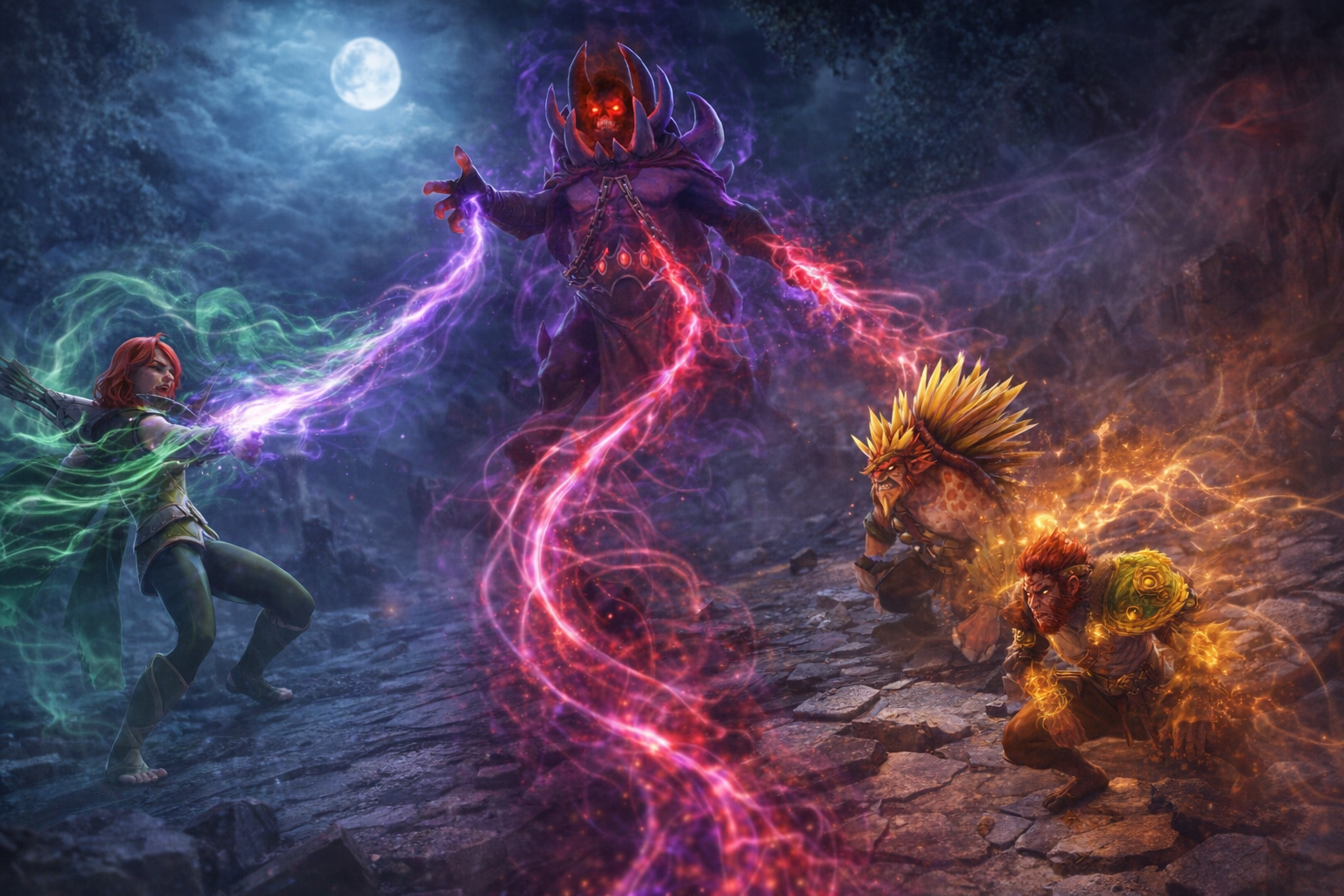
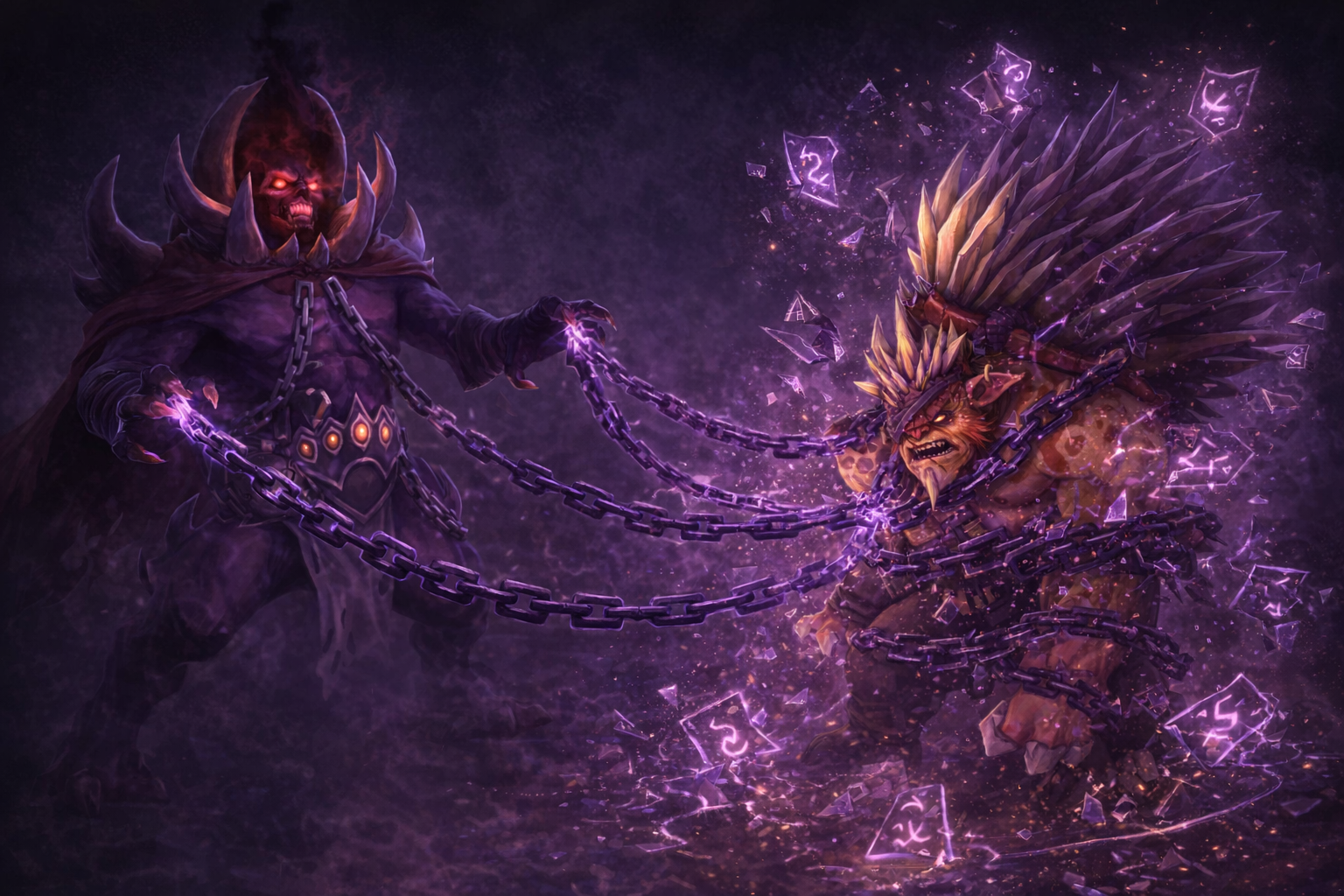
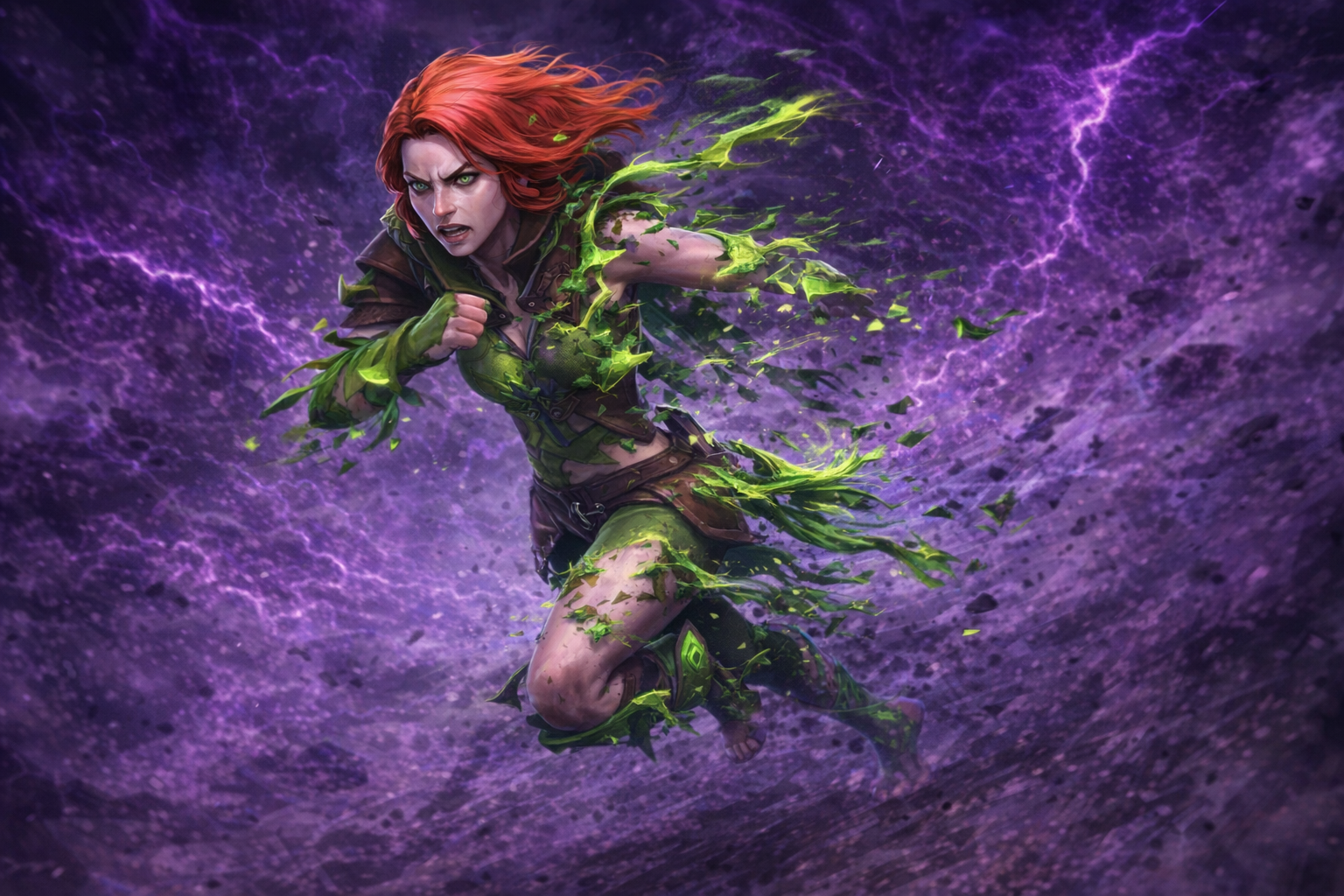
You’ve seen the fight go sideways in a way that feels illegal. Windranger gets tagged and suddenly can’t keep her movement buff. Bristleback gets hit by the same spell and keeps standing there like a wall with a bad attitude. Monkey King loses one thing, keeps another, and the whole interaction looks inconsistent until you actually parse what Dota is checking under the hood.
That confusion is where Shadow Demon exposes one of Dota’s oldest language problems. Players use purge, dispel, and break like they all mean “remove the annoying thing.” They don’t. Shadow Demon’s ultimate is one of the cleanest places to learn the difference, because Aghanim’s Scepter changes it from a nasty utility spell into a direct answer for an entirely different category of hero.
Shadow Demon’s ult teaches the vocabulary fast
Shadow Demon’s ultimate applies a strong form of control over the target’s status. The important part for this discussion is simple: by default, it repeatedly strips away removable buffs while slowing the target. With Aghanim’s Scepter, it also applies Break.
Those are separate functions.
A purge or dispel interacts with buffs and debuffs. Break interacts with passive abilities. If you remember that distinction, most of the weird cases stop being weird.
Purge is about status effects
When a spell purges or dispels an enemy, it removes positive effects that are actually present on that hero as buffs, assuming those buffs are dispellable. Picture glowing states, temporary protections, move speed steroids, immunity-style tools that say they can be dispelled, or item effects currently sitting on the unit.
Shadow Demon’s ultimate is brutal against heroes who rely on maintaining one of those states. A target who wants to keep a mobility buff or a temporary defensive layer can get that effect stripped away over and over while the ultimate is active. That’s why some heroes feel pinned in place by the spell even if they technically still have buttons to press.
It also explains why the spell feels so disrespectful against item saves. You pop a defensive item, expect a window to reset the fight, and Shadow Demon says no. If the effect is a removable buff, Purge keeps tearing it off.
Break is about the hero’s wiring
Break is a different beast. It disables passive abilities that are marked as breakable. That means the hero still exists, their model is still there, their stats are still there, but the built-in passive rule set stops functioning for the duration.
That’s where Shadow Demon’s Aghanim’s Scepter comes in. Without it, his ultimate is excellent at ripping off removable buffs. With it, the spell starts attacking the target’s passive identity.
Bristleback is the classic example because the result is obvious. His back-facing damage reduction comes from a passive. Purging him does nothing to that passive. Breaking him does.
That’s the answer to the original point of confusion in one sentence: Shadow Demon’s ult already removes buffs, but Aghanim’s adds the ability to disable passives, and those are different systems.
Why the confusion keeps happening
Dota has never been interested in making this intuitive. It uses overlapping visual language for effects that are mechanically distinct, then stacks them on the same hero.
A lot of abilities create a buff through a passive. A lot of passives can be represented by an icon. Some heroes have a passive that grants a temporary active state. Some item effects look like a passive but are actually a buff. You end up with the same practical question every fight: can this be removed, or does it need to be broken?
The Monkey King problem
Monkey King is a good example of why players mix these terms up. Jingu Mastery comes from a passive ability, but once it’s charged, it produces a buff state on Monkey King. Those are two layers.
A purge can remove the buff state if it is dispellable. Break disables the passive source so he can’t keep leveraging that passive normally while broken. If you only think in hero names and not in mechanics, this sounds contradictory. If you think in layers, it makes perfect sense.
Dota does this all over the roster. One hero has a passive that grants a visible status. Another has a passive that permanently modifies how damage is processed. Another has a passive that triggers procs or survival clauses. Purge and Break touch different parts of that stack.
What Shadow Demon is actually buying with Aghs
Aghanim’s Scepter on Shadow Demon isn’t there to make Demonic Purge “work properly.” The base spell already works. Aghs changes what problems the spell can solve.
Without Scepter, your ult is a chase tool, a dispel engine, and a way to punish heroes leaning on removable defensive states. It’s amazing against targets who survive through buffs, items, or movement-based protection.
With Scepter, the spell becomes a counterpick purchase in item form. Suddenly you’re not only stripping temporary protections. You’re shutting off passives that define entire heroes.
That matters because many of the most obnoxious cores in pub Dota are obnoxious specifically due to passive design. They don’t need perfect execution to be threatening. They need time. They need to stand there and let the passive do the work. Break attacks that foundation directly.
The Bristleback test
If the enemy draft has a Bristleback who wants to walk uphill and force the game into a damage sponge contest, Aghs changes your contribution from irritating to essential. Purge alone won’t erase the core reason he’s hard to kill. Break does.
That doesn’t mean every Bristleback game automatically demands the item. It means the item has a clear target profile. When the enemy’s frontliner depends on a breakable passive to absorb pressure, Shadow Demon can convert one spell into a kill setup instead of just a slow and dispel.
The anti-cheese value
Aghs also matters against heroes whose “why is this hero allowed to do that” moments come from passives rather than active spell usage. Shadow Demon already punishes visible buffs and many item-based escape patterns. Scepter closes the gap against heroes who don’t need a visible buff to be miserable.
That distinction is huge in actual drafts. Some lineups fold to dispel. Others fold to Break. If you buy the wrong answer, you still cast a good spell, but you never touch the reason the enemy hero is winning fights.
The feel of the spell is what tricks people
Part of the misunderstanding comes from how Demonic Purge looks in motion. You cast it on a target and they seem stuck inside the effect. They can’t maintain certain defensive states. They can’t cleanly disengage with the usual item sequence. It has that “everything is being disabled” feeling.
That feeling is deceptive.
The target can still keep any passive that hasn’t been broken. If their durability or damage pattern is built into a passive, they retain it unless Aghanim’s is involved. So the spell can feel overwhelming against one hero and underwhelming against another despite using the same cast, because the second hero’s power isn’t living in dispellable buffs.
Windranger shows the other side cleanly
Windranger makes the default version of the spell look absurdly strong. A mobility-based defensive buff is exactly the kind of thing Purge loves to ruin. You cast ult, she tries to rely on that buff state, and the effect keeps getting removed. The hero feels trapped.
That interaction can mislead you into assuming the spell also shuts off a hero like Bristleback the same way. It doesn’t. Windranger’s key survival moment in that exchange is tied to a removable buff. Bristleback’s key survival moment is tied to a passive rule attached to his hero.
Different lock. Different key.
Pub players undervalue “answer items” on supports
There’s a bad pub habit where support itemization gets judged only through broad usefulness. Save item good. Team aura good. Big cast range good. Those are all real, but they can flatten your thinking.
Shadow Demon punishes that laziness because he scales through interaction quality. If the enemy lineup is asking a very specific question, you want the item that gives a very specific answer.
Aghanim’s Scepter is one of those answers.
You buy it when the enemy has break-sensitive passives that your team otherwise struggles to address, or when your lineup needs your ultimate to carry more than one kind of utility in the same fight. The purchase gets even better when the same enemy core also hates being dispelled. Then one cast attacks multiple layers of their game plan.
This is why experienced Shadow Demon players look smug
There’s a special kind of control Shadow Demon brings when he has the right target and the right item timing. The enemy tries the standard escape sequence, reaches for a defensive buff, maybe expects their passive durability to cover the rest, and instead gets dragged through the full rules lesson in real time.
They can’t keep the buff. They can’t trust the passive. They can’t create the usual spacing.
That’s why the hero feels so satisfying when he’s good. He doesn’t just reduce numbers. He removes assumptions.
The mechanical checklist you should actually use
When you’re deciding whether Shadow Demon’s ult already handles a problem, ask one question first:
Is the thing making this hero strong currently a removable buff, or is it a passive ability?
If it’s a removable buff, Demonic Purge already has game.
If it’s a passive ability, you’re looking at Break territory, which means Aghanim’s Scepter matters.
If it’s both, separate the layers and identify which one is deciding the fight. That prevents the classic mistake of seeing one piece get removed and assuming the whole threat is solved.
A practical read during a match
You don’t need encyclopedic memory for every interaction. You need the habit of classifying what you’re seeing.
Did the hero activate something and gain a visible state that can usually be dispelled? Purge is relevant.
Is the hero just standing there benefiting from a built-in passive effect with no removable state to attack? Break is relevant.
Is the passive creating a temporary buff after some condition is met? Then both mechanics may matter at different moments.
That frame cleans up a lot of Dota’s fake complexity. The game still has edge cases, but the broad logic holds up well enough to make better purchases and better target calls.
Why this matters beyond Shadow Demon
Shadow Demon is just the easiest teacher because his Aghs puts both concepts on the same spell. Once you understand why his Scepter exists, a lot of hero and item interactions across Dota become clearer.
You stop asking whether a spell “removes everything” and start asking what category of effect it touches. You get better at identifying when your team needs a dispel, when it needs Break, and when you’re wasting resources trying to solve a passive hero with buff removal.
That’s the real value here. It sharpens your read on fights.
And if you play Shadow Demon, it sharpens your cruelty. Few things in Dota are funnier than watching someone reach for the usual answer and discovering your ult was aimed at the answer itself.