Why Position 4 So Often Feels Like Sabotage
Why does your position 4 so often feel like the guy most likely to ruin the game?
You know the sequence. You load in on offlane, already thinking about creep equilibrium, the first lotus, whether their safelane can actually kill you at level two. Your support hovers something flashy, buys almost nothing that helps the lane, then starts playing his own private minigame. Ten minutes later your wave disappears to a random nuke, your jungle route gets vacuumed up by a hero with a support badge, and the map somehow has less vision than if nobody had bought wards at all.
That feeling is real. It also points to something bigger than one bad Rubick or one serial-hook Pudge. Position 4 is the least socially stable role in Dota, and the role itself invites confusion, greed, freelancing, and just enough plausible deniability for people to call griefing “playmaking.”
The role with the widest job description
Position 5 has a clearer social contract. Protect lane, spend gold on team utility, accept that your farm comes last unless the game breaks open. Core roles also have obvious priorities. Hit timings. Hold map areas. Convert farm into pressure.
Position 4 lives in the cracks between all of that.
A good 4 can dominate lane trades, drag waves, secure runes, rotate mid, block camps, unblock camps, contest pulls, defend towers, smoke first, start fights, save cores, shove dangerous lanes, and scale into utility or damage depending on what the game needs. That flexibility is what makes the role fun. It also makes it the easiest role to justify almost anything on.
A player can abandon lane and call it active roaming. They can soak farm and call it scaling. They can miss every timing that matters and still point at one fight where they landed a spell and say the game was playable because of them.
That’s why position 4 attracts two very different kinds of players. One group loves reading the map and creating chaos in useful places. The other wants the freedom of a core without the accountability of being labeled one.
Why the hero pool makes the problem worse
Many classic 4 heroes are built around visible, high-drama moments. Pudge gets to fish for hooks. Rubick gets to steal a spell and feel clever. Windranger can look like a solo-kill machine. Hoodwink always has another wave to nuke and another tree line to play around. Sniper support exists in that irritating gray zone where one decent lane can suddenly justify a build path that was obviously headed toward personal DPS from minute one.
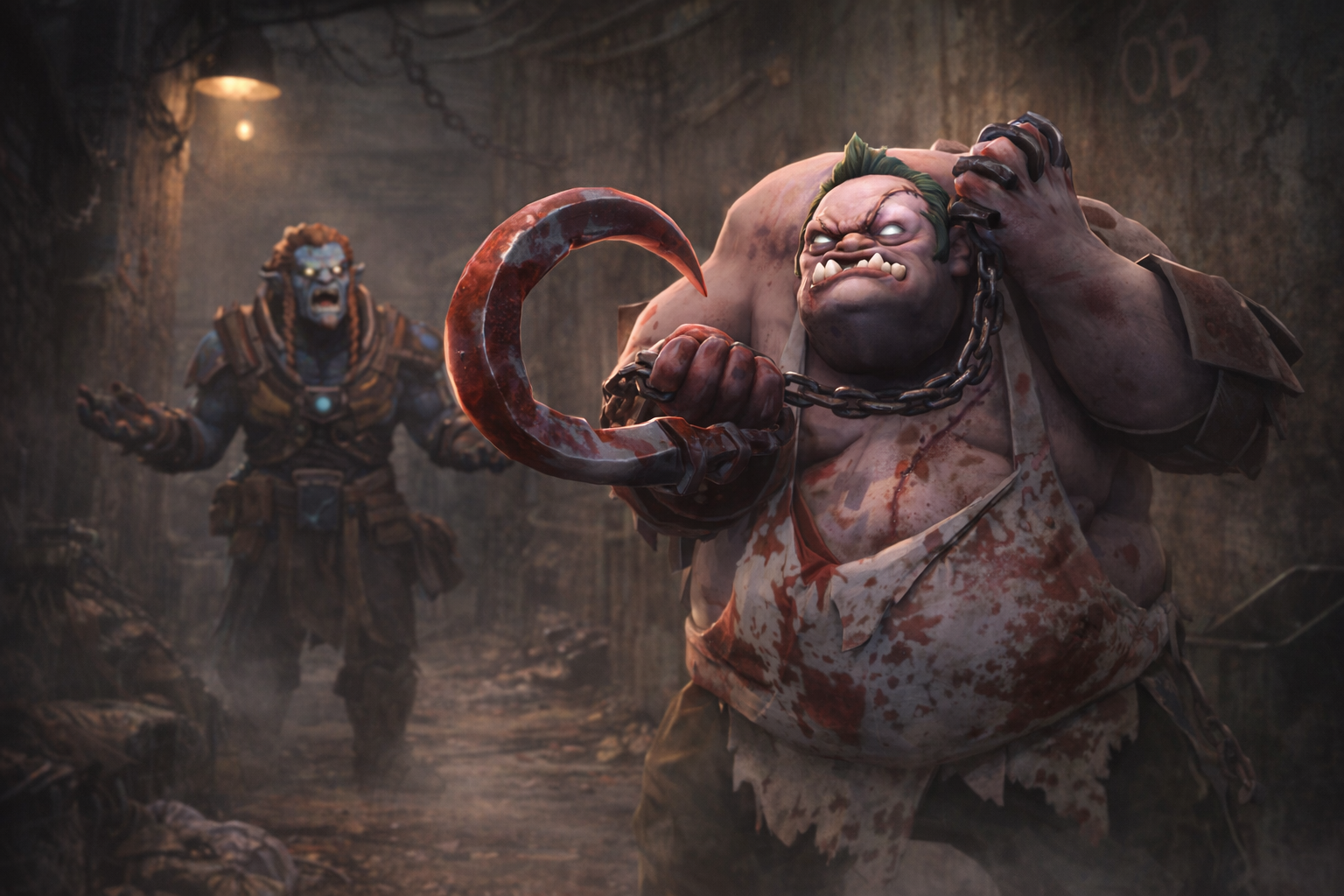
These heroes offer constant temptation. Every spell asks the same question: do you want to help your core, or do you want to have fun right now?
A disciplined 4 answers both. A bad one picks the second option every time.
The problem is that Dota often rewards the bad version just enough to keep the habit alive. A support who lands one flashy initiation gets praise. A hero who steals two kills can stumble into item progression. A Pudge who misses hooks for 20 minutes and connects on a couple in the late game can end with MVP graphics and a clean memory of his own performance. The offlane he abandoned and the map pressure he never helped create don’t show up as brightly.
Soft griefing is still griefing
The word griefing gets thrown around too casually in Dota, but there is a category of behavior that deserves the label even when it isn’t outright running down mid.
Soft griefing is when a player follows just enough of the script to stay defensible while undercutting the job their role is supposed to do.
That’s the support who uses spells to “secure” lane creeps that were already secured. The one who places the most obvious ward on the map and mentally checks out of vision for six minutes. The one whose quickbuy screams selfish progression while their inventory stays one cheap utility component away from being useful for half the game. The one nuking waves the moment they see them because lane gold feels more reliable than making a read on where they actually need to be.
None of these actions look criminal in isolation. Put together, they create a game state where your team has one fewer support than the scoreboard claims.
That distinction matters because the frustration usually comes from pattern, not a single mistake. Every position 4 misclicks a wave or takes a creep they shouldn’t. That’s Dota. The real damage starts when your 4 consistently chooses gold, spellcasting freedom, or personal highlight hunting over the invisible work that lets cores play normal Dota.
The lane is only half the role
A lot of offlaners can survive a mediocre lane partner. You can trade your own HP well enough, drag the wave back, play near tower, recover through cut waves or jungle access. So the lane phase often disguises the problem.
A position 4 can be tolerable for eight minutes and disastrous for the next twenty.
That’s where the resentment comes from. If a support is weak in lane but later enables smoke moves, protects your tower area, breaks dangerous waves, and shows up with useful items, you forgive a lot. If they behave in lane and then start cannibalizing the map, they become harder to play around than a support who was openly bad from minute one.
The classic version is wave theft during core movement. You’re pathing to a lane because the next camp sequence lines up with it, and your 4 fires two spells into the wave because they happened to be nearby first. Or you’re recovering after a rough start, finally getting access to a safe section of map, and the support hero with superior nuke range decides your comeback route belongs to them.
This isn’t only about net worth. It’s about rhythm. Core farming patterns depend on chains of efficient movement. Break the chain often enough and you don’t just lose a wave. You lose the timing attached to it.
Why position 4 attracts greedy players
The role has always been the greedier support slot. That isn’t a problem by itself. Greed is part of the design. A lot of great 4s need levels and one or two meaningful items to hit their real impact window.
The issue starts when greed stops serving tempo and starts replacing it.
A healthy position 4 build says: once I get this item, I can start fights more reliably, save a core, force reactions, or occupy dangerous map areas. An unhealthy one says: once I finish pretending to build support, I can finally play the game I wanted to queue for.
You can usually tell which version you’re dealing with early. Look at movement, not item icons. Does the hero play toward runes, catapults, gate rotations, and power spikes? Or do they drift toward the nearest source of guaranteed gold every time the map becomes uncertain?
That’s why something like Treads into utility components can still smell terrible. The issue isn’t that a support bought stats. The issue is the pathing, spell usage, and lane occupation that make it obvious those items are a bridge to becoming another core.
The role is genuinely hard
There’s another side to this, and it matters if you want to win more games instead of just being right about why your support annoyed you.
Position 4 has more branching decisions than almost any other role in the early game. Stay in lane or rotate. Contest pull or drag wave. Pressure mid or protect your offlaner. Secure wisdom timing or keep catapult alive. Show on map to defend tower or vanish and threaten a move.
A lot of players are bad at 4 because the role demands constant judgment under uncertainty. There often isn’t one clean, correct line. There are five plausible lines and two of them become grief depending on what your cores are doing.
That complexity creates a lot of accidental sabotage. Some position 4s aren’t selfish. They’re lost. They know the role can roam, scale, shove, defend, initiate, and protect, and they don’t yet know which version matters in this game.
That doesn’t make the experience less miserable for the offlaner dealing with it. It does explain why the role produces so many games that feel weird rather than simply bad.
Why offlaners feel this more than anyone
Mid sees the 4 in short bursts. Carry usually measures supports by whether the lane was playable and whether stacks or saves appeared later. Offlane lives with the role up close.
Your lane partner shapes whether you can pressure, whether you can pull the wave back, whether enemy pulls get punished, whether your level timings arrive on schedule, and whether the first ten minutes create an actual threat on the enemy carry. Then the same player often controls whether your side of the map stays usable after lanes break.
When position 4 underperforms, the offlaner pays twice. First through lane friction, then through map starvation.
That double tax is why so many 3 players become paranoid the moment their 4 walks toward a wave. The behavior gets trained into you. You start last-hitting faster than necessary, nuking preemptively, and assuming every neutral camp in your route is already spiritually reserved by your support.
How to play around the greedy 4 without losing your mind
You won’t reform random players through moral argument in all-chat or team chat. You need game actions that lower the damage.
Make the lane job explicit
A lot of position 4 players improve when the first 30 seconds are simple and concrete. Ask for pull contests, body blocks, lotus control, or pressure on one target. Short instructions work better than abstract complaints about “supporting.” Give them a task tied to the next minute of gameplay.
Read the hero honestly
If your 4 picked a greed-prone hero and already shows farm-hungry movement, stop expecting textbook support behavior. Plan around what they are actually doing. That might mean taking more conservative lane trades, dragging waves yourself, or rotating earlier than you normally would because your partner is turning into a side-core.
Protect your farming pattern
If your support keeps clipping your lane access, change route sooner. Take the dangerous wave they don’t want, ask another core to occupy the safer area, or force a move with your timing instead of competing over scraps. Ugly adaptations win games all the time.
Use their greed when it creates pressure
Some fake-support 4s are still useful if they hit heroes and force reactions. If they insist on becoming a semi-core, treat them as one. Play around their spike when it arrives. Dota has always rewarded teams that recognize what they actually drafted, even by accident.
There are games where the highest-EV move is effectively letting the “support” take a larger share of farm while you shift into utility and tempo. Matchmaking often isn’t built around that allocation. If the greedy player can convert resources into real threat and you can still function, the game may become more winnable once everyone stops roleplaying the original labels.
What a real position 4 looks like
The best 4s feel unfair in the opposite direction. They don’t need much explanation because every move makes your game easier.
They know when a ranged creep needs help and when your animation already had it covered. They understand that showing on a dead lane to collect one wave is different from erasing three consecutive core routes. Their first meaningful item arrives with purpose attached to it. They create information through vision and presence instead of scattering observers like apology notes. When they rotate, something changes on the map.
That’s the standard players are really comparing against. Not perfection. Functional intent.
Position 4 feels like griefing so often because the role gives cover to selfish instincts and punishes indecision in ways your teammates absorb before you do. It asks for support habits, core mechanics, map sense, and restraint with just enough freedom to fake competence. When those pieces line up, the role is one of the most impactful in Dota. When they don’t, you get a hero farming your lane, pinging their almost-finished item, and calling it impact while your game slips out through the side door.