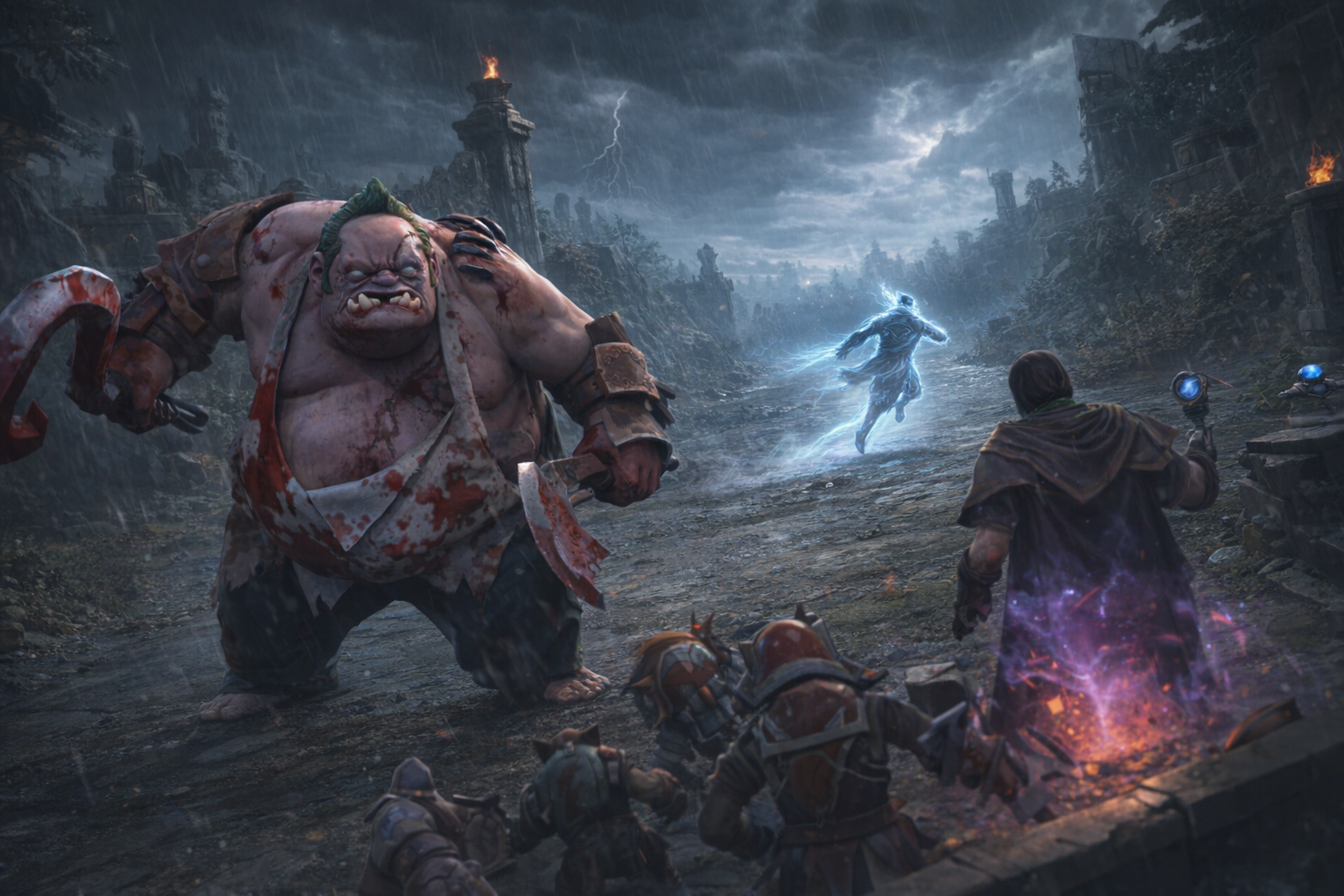
Low-MMR players love the clean moral rule: never first-pick a new hero in ranked. That rule feels satisfying, and it explains absolutely nothing. If you want fewer ranked games wrecked by a guy announcing “first time” after the horn, you need the real answer: the system rewards it, the culture tolerates it, and most players massively overestimate how much hero familiarity matters compared to role familiarity, lane fundamentals, and emotional control.
You’ve lived this game. Draft ends, your position four locks Pudge, your mid hovers a flashy spirit, and ten seconds before creeps spawn somebody types that they’ve never actually played the hero before. Then the lane starts exactly how you fear. Missed spell, bad trade, wrong item, panic TP, silence in chat, slow collapse. The easy reaction is rage. The useful reaction is understanding why this keeps happening and what you can do when it does.
Ranked Is Where Dota Actually Happens
The first thing to accept is brutal: for a huge slice of the player base, ranked is the main game and everything else is side content.
Unranked often has messy role distribution, lower buy-in, weirder drafts, and less reliable lane structure. If someone wants ten reps on a mid hero, ranked role queue gives them the closest thing Dota has to a controlled environment. They get the lane they asked for more often. They face opponents who are trying. They get a game that resembles the matches they actually care about.
That doesn’t make the decision polite. It makes it logical.
A lot of players don’t see unranked as “practice mode.” They see it as bad data. If the game quality is lower, if drafts are random, if supports are experimenting, if teammates are half-trolling or half-watching something on another monitor, then the lessons from those games feel weak. A player trying to learn a mechanically demanding mid hero may decide that getting stomped in a serious ranked lane teaches more than cruising through a chaotic unranked lobby.
You can disagree with that choice and still recognize the incentive structure behind it.
The Real Reason: Role Practice Beats Hero Practice
Most disastrous first-time picks look like a hero problem. A lot of them are really role problems.
A player who has never touched Pudge but has spent hundreds of games as a roaming support still understands where the lane meets, when to pull, how to trade around creep waves, when to rotate, and how to play around vision. Their hooks may be ugly, but the game can still be functional.
A player on their comfort hero in an unfamiliar role can grief a match much harder. Put a lifelong carry player onto support with their most played hero and you still get missed pulls, bad ward timing, greedy itemization, and useless map movement. Dota punishes role ignorance every minute. Hero ignorance spikes hardest in the specific moments where that hero’s toolkit matters.
That distinction matters because it explains why people feel justified first-timing in ranked. They aren’t always thinking, “I have no clue what this hero does.” A lot of the time they’re thinking, “I know this lane, I know this job, I know the map, I just need reps on this spell kit.”
Some Heroes Are Learnable on the Fly. Some Are Loaded Weapons.
The anger usually spikes when players pretend all first-time picks are equal. They aren’t.
There are heroes whose floor is mostly generic Dota. You can contribute with basic spell usage, decent positioning, and sane item choices. If your fundamentals are solid, your first few games can be ugly without becoming unplayable.
Then there are heroes whose value depends on one or two precise patterns. Pudge is the classic example because every missed hook is public. Everyone sees it, everyone remembers it, and every whiff feels like a written confession. Invoker, Meepo, Arc Warden, Chen, Earth Spirit, Lone Druid, Broodmother, and a handful of others carry a similar tax in different ways. These heroes ask for muscle memory, tempo sense, and matchup knowledge before they stop bleeding value.
That’s where teammates lose their minds, and with reason. The issue isn’t novelty by itself. The issue is choosing a hero with a steep execution curve and pretending raw confidence covers the gap.
The Visibility Problem
There’s another layer to why some first-timers draw more hatred than others: visible failure.
A new Juggernaut who farms too slowly and takes the wrong fight timing can still look vaguely normal for fifteen minutes. A new Pudge misses a hook in vision and the whole team experiences the mistake in real time. A new Io or Oracle can quietly sabotage a game through poor spell usage that lower brackets barely identify. A flashy skill-shot hero turns every error into theater.
That public embarrassment makes people believe those heroes are uniquely griefing. Sometimes they are. Sometimes they’re just louder.
“MMR Is Just a Number” Isn’t a Joke. It’s a Worldview.
You run into players with completely different reasons for queueing ranked, and that difference creates half the conflict before the draft even begins.
Some players treat MMR as a long-term skill measurement. Every match is a serious investment. Their draft choices are conservative because they want to maximize win probability right now.
Others use ranked as their only meaningful matchmaking environment. They still want to win, but they also want to improve, test heroes, farm role queue tokens, or avoid the nonsense they associate with unranked. Their relationship to rating is looser. They’ll spend short-term MMR to build competence on a hero they plan to add to their pool.
Those two mindsets can sit on the same team and instantly resent each other.
One player sees disrespect. The other sees normal progression.
Neither side is going away because Dota doesn’t split these motivations cleanly. The queue puts climbers, experimenters, grinders, token farmers, role specialists, and casual ranked players in the same box, then asks them to share a single definition of “trying.” Good luck with that.
Role Queue Quietly Pushes People Into Weird Picks
###[[image anchor placeholder removed]]
Role queue solved one major problem and created a smaller, more annoying one.
When players need role queue tokens, some of them will queue for roles they don’t care about just to earn future games on their preferred role. Once they land there, they often default to a familiar archetype, a comfort button, or whatever hero they’ve wanted to test. That’s how you get support players who behave like underfunded cores, offlaners who pick greed into bad lanes, and random first-timers who look suspiciously detached from the result.
Even when a player genuinely wants to learn a hero for a role, ranked is the only place where the role is guaranteed often enough to build repetition. Repetition matters in Dota more than isolated matches do. A single unranked game teaches very little if the next four matches put you in a different lane. Players who want focused reps will go where the system lets them get focused reps.
That’s a design reality, not a morality tale.
Hero Familiarity Is Overrated by Teammates and Underrated by the Player Picking It
Both sides of this argument distort the real cost.
Teammates often assume a first-time hero means automatic loss. That’s too simple. A stable player on a straightforward hero can absolutely function in ranked without prior matches. If they understand their job, buy sensible items, and avoid ego plays, they can be fine.
The person picking the hero often makes the opposite mistake. They assume understanding the hero conceptually means they’re ready for ranked. Watching streams, reading tooltips, and seeing the hero in pubs gives you a skeleton. Actual games reveal animation feel, damage windows, cast range intuition, lane friction, and what panic looks like when your buttons get messy. Dota punishes uncertainty in tiny timing mistakes long before it punishes obvious ignorance.
That’s why first-time picks feel like betrayal to teammates. The picker is usually underestimating how many micro-decisions are built from habit.
Mechanical Knowledge vs Match Experience
You can know what a hero wants to do and still fail every practical checkpoint.
Laning on an unfamiliar hero means misjudging when you can trade. It means fumbling last hits because attack animation feels wrong. It means spending mana at bad moments, standing in the wrong pocket of the lane, or taking a rune fight with the wrong resources. Even support heroes demand instincts that only appear after a few games.
That’s the practical correction most players need. The damage from first-timing rarely comes from some giant misunderstanding of the hero fantasy. It comes from ten small errors in the first eight minutes.
Why People Still Do It Anyway
Because Dota players are human, and humans optimize for convenience, confidence, and mood before they optimize for your ideal queue etiquette.
Some people are bored of their comfort pool.
Some are convinced the hero is easy enough.
Some just watched a great performance and want to copy it immediately.
Some value learning over short-term rating.
Some barely care about rating at all.
Some are smurf-adjacent in confidence without the mechanics to support it.
Some are perfectly serious and simply wrong about their readiness.
The important part is that all of these motivations are stable. You are not one rant away from reforming ranked culture.
What Actually Wins You More Games When This Happens
Getting mad at the first-time picker feels righteous and usually lowers your win chance on the spot.
Your useful options start with identifying what kind of first-timer you got.
If it’s a mechanically shaky player on a high-execution hero, simplify the game around them. Give cleaner calls. Avoid greedier map splits. Fight around obvious cooldown patterns instead of expecting creativity. If your support is clearly uncomfortable, stop building your lane around ideal spell usage that isn’t coming.
If it’s a role-competent player learning a new kit, treat them like a normal teammate with narrower options. They can still play for runes, towers, and item timings. Most first-timers fail hardest when the game becomes improvisational chaos. Structure helps.
If they announce it in draft, use the information. Adjust lanes if your lineup allows it. Shift responsibility away from the player trying to juggle too much. Drafting and lane allocation are often the last chance to turn “grief pick” into “manageable game.”
And if they start spiraling after early mistakes, your best weapon is still emotional containment. Ranked Dota is full of players who can recover from a weak start and almost none who recover after being turned into the team scapegoat at minute four.
The Better Rule for Your Own Ranked Games
The blanket rule isn’t “never play new heroes in ranked.” That rule gets ignored because it’s detached from how people actually use the mode.
The better rule is sharper: don’t debut heroes in ranked when their value depends on muscle memory you do not have yet, and don’t do it in roles where your baseline game understanding is weak.
If you want to expand your pool responsibly, start with heroes adjacent to what you already play. Support players can branch into supports with familiar lane tasks. Mid players can learn new mids that preserve their tempo instincts before jumping into exotic micro or combo-heavy kits. Carry players can test new farming patterns on heroes that still obey familiar fight timing. Respect the transfer of skill you already own.
And if you insist on first-timing anyway, pick like someone who understands the social contract of ranked. Choose lower-variance heroes. Keep your itemization boring. Skip the highlight-reel plays. Let the game come to you.
The player who locks a new hero and plays simple Dota is annoying. The player who locks a new hero and demands the whole team survive their self-discovery project is the one everybody remembers.
Ranked Culture Will Never Be Pure
A lot of frustration comes from expecting ranked to be a sacred competitive space with one shared purpose. Dota has never worked like that. Ranked is where ambition, habit, boredom, improvement, ego, and convenience all queue together.
You can hate that reality. You still have to play inside it.
The fastest climb usually comes from dropping the fantasy that every teammate values the match exactly the way you do. Once you stop expecting alignment, the draft becomes easier to read and the game becomes easier to salvage. That doesn’t excuse the guy first-timing a hero with no reps and no shame. It just puts your attention where it belongs: on adaptation instead of outrage.
That’s the ugly little truth behind the “first time hero” confession in ranked. It keeps happening because the game gives players reasons to do it, and because enough of those games are still winnable that they never feel forced to stop.