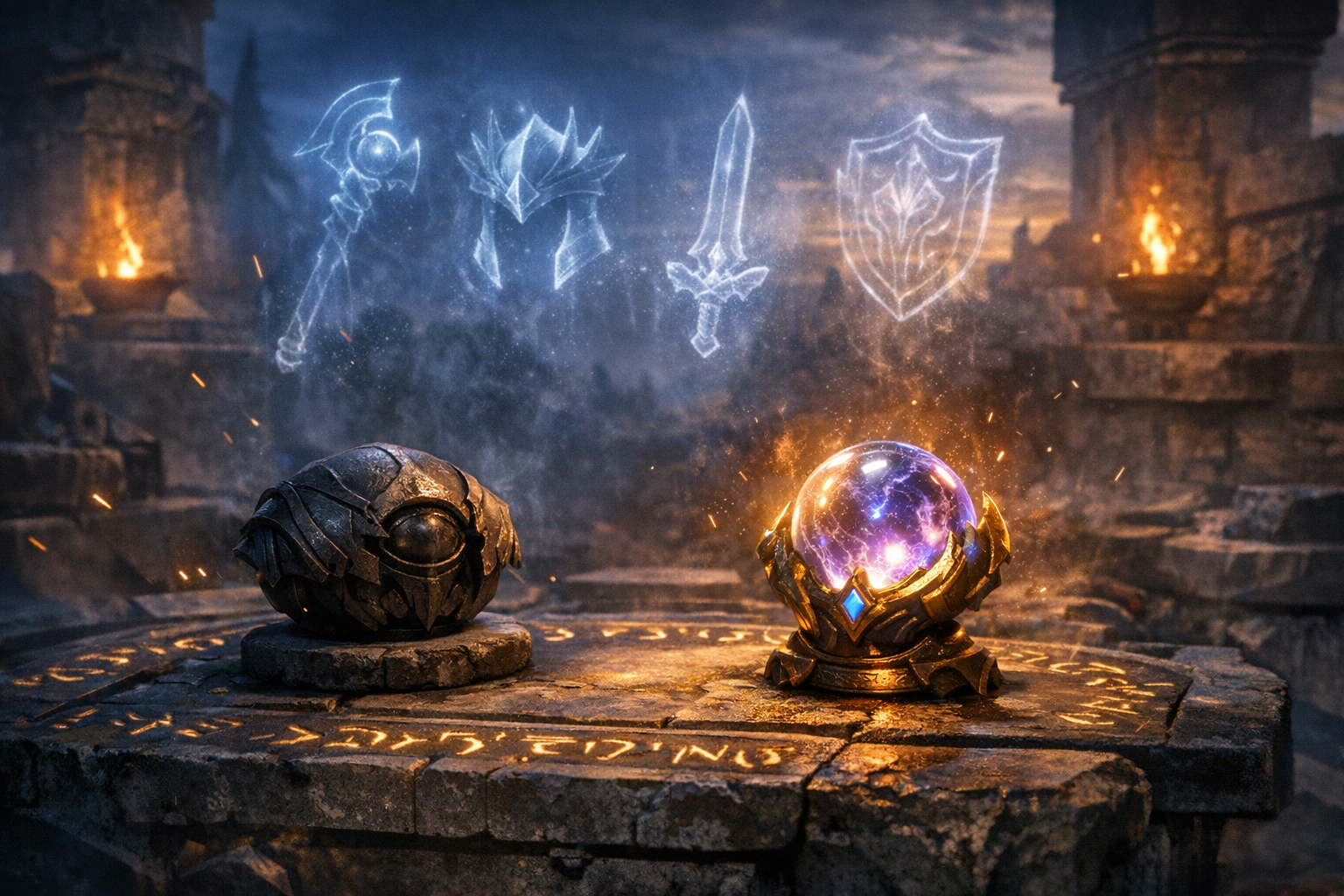
The myth is simple: these neutral items are bugged, fake, or do literally nothing. You pick one up, your hero sheet barely changes, the shop gives you no satisfying feedback, and demo mode turns the whole thing into a clown show. You stare at the tooltip, craft again, and still feel like Dota just slipped a joke item into your backpack. What these items actually do is much narrower, more delayed, and way less readable than most players expect.
The Real Problem Is Visibility
Dormant Curio and Enchanter’s Bauble break a basic rule of Dota item design: when you equip an item, you expect your hero to become stronger right now. More damage. More stats. A spell amp line changes. A cooldown number moves. Some clean little proof that the slot mattered.
These two don’t play that game.
They are investment neutrals. They affect the next thing you craft rather than your current hero state in an obvious, immediate way. That single design choice is why they generate so much confusion. Dota has trained you for years to judge value by instant feedback. These items hide their payoff behind the crafting system, and the game does a poor job of surfacing when that payoff is active, what exactly it applies to, and whether the gain is even worth the delay.
That confusion gets amplified in testing. If you try to brute-force neutrals in demo through the shop, you can end up with behavior that feels inconsistent or flat-out wrong. So players come away convinced the tooltips lie. The issue is less about the underlying concept and more about how clumsy the implementation feels when you try to verify it.
What Dormant Curio Actually Does
It buffs your next neutral craft
Dormant Curio is a forward-looking neutral. It doesn’t juice the item you already have. It improves your next crafted neutral outcome. The effect applies to the next craft where the relevant neutral options are presented with the boosted bonus.
That means your hero can hold it and appear unchanged. No dramatic stat swing. No instant power spike. The value is stored in the next decision point.
If you were expecting a live effect while it sits in your inventory, the item feels dead. That’s the core misunderstanding.
Why the item feels invisible
Dota players are trained to scan numbers. Attack speed, HP, mana pool, cast range, resistances. Curio hides from that entire habit. Its value shows up when the next neutral craft happens, and only on the subset of options it affects.
That creates a nasty UX problem. You pick it up now, but the payoff window might be minutes away. During that gap, every other neutral with an immediate combat effect feels more honest.
When it actually makes sense
Curio has a real use case. It’s strongest when your current neutral timing is awkward and the next tier is close enough that banking power forward beats taking a mediocre immediate option.
A common example is when you’re late finding or caring about an early-tier neutral and the next tier matters more to your hero. In that case, Curio acts like deferred efficiency. You sacrifice current impact for a stronger roll or stronger version of the next craft.
It becomes much worse when the game is unstable, when you’re about to fight over towers or Roshan, or when your hero desperately needs a real item effect this minute. Dota punishes delayed value hard. If your team is grouping and you’re holding a neutral IOU, you can easily grief your own timing.
What Enchanter’s Bauble Actually Does
It scales your enchantment bonus over time
Enchanter’s Bauble is even more confusing because the payoff is both delayed and hard to see. It doesn’t present itself like a normal combat neutral. It increases the strength of your enchantment bonus, and that bonus grows further each time you keep investing through the system.
The important part is this: the item is about improving the enchantment percentage rather than giving you a clean standalone stat line in the inventory.
So if you equip it and expect your hero to suddenly cast faster, hit harder, or tank more, you’ll feel scammed. The gain is attached to the enchantment layer, which is much easier to miss unless you hover and inspect carefully.
Why players think it does nothing
Bauble asks you to trust hidden math in a system that already has too many moving parts. You need to understand that the enchantment value changes, then know where to look, then decide whether the increased percentage matters for your hero, and then wait long enough for repeated scaling to become meaningful.
That’s a lot.
The item also suffers from a brutal practical issue: many matches simply don’t last long enough for the scaling fantasy to matter. Dota is full of mechanics that are theoretically amazing at minute 65 and basically irrelevant at minute 28. Bauble lives closer to that camp than most players want from a neutral slot.
The long-game item in a short-game slot
Neutral slots are usually where you want clean utility or raw efficiency. Move speed. Survivability. Mana sustain. Fight-ready damage. Bauble competes against options that help you immediately win the next skirmish. That makes it hard to justify unless your game state clearly points toward a long match and your hero benefits heavily from a stronger enchantment.
If the game is heading toward six-slot territory, repeated scaling starts to sound attractive. If the game is still being decided by one smoke, one high ground defense, or one pickoff on a core, then delayed enchantment growth is a luxury purchase.
Why These Items Clash With How Dota Players Evaluate Power
Dota rewards visible strength
You trust what you can feel in one spell cycle or one right-click exchange. If an item changes a kill threshold, saves you from burst, or lets you farm one camp faster, it earns your respect instantly.
Curio and Bauble live outside that loop. Their strength is abstract. It sits in future crafting value, future enchantment value, future payoff. That makes them mentally expensive even when they’re technically efficient.
Dota has plenty of delayed-value mechanics, but the best ones communicate hard. Hand of Midas tells you exactly what it’s doing. A farming item changes your map speed immediately. Auras broadcast their existence every fight. Curio and Bauble ask for faith.
Faith is a terrible interface.
Inventory slots are too precious for ambiguity
A neutral slot may be separate from your six normal slots, but it still carries an opportunity cost. Every moment you hold an item with unclear present value, you’re declining something that could affect the next fight.
That matters more in pubs than in theorycraft.
Most pub games are chaotic, timing-driven, and full of uneven execution. Value that arrives later often dies on the road there. A support gets caught warding. A carry joins one fight too early. A team throws high ground. The game state mutates before your clever investment item matures.
That’s why even when these neutrals are working correctly, many players still feel they’re bad. The issue shifts from understanding to trust. You understand the text and still don’t want the slot burden.
The Pub Reality Check
Dormant Curio has a narrow but real window
Curio is reasonable when you can map out the next neutral timing and you know your current alternatives are weak for your hero. It works best on heroes who care a lot about hitting the next useful neutral breakpoint and can survive a short stretch without immediate slot power.
That usually means a stable game, decent map access, and no urgent need to brawl every minute.
If you’re losing map control, don’t get cute. If your lineup needs to scrap now, don’t bank future value. If your current neutral choices are already serviceable, take the stats and play Dota.
Enchanter’s Bauble is a greed check
Bauble asks a blunt question: are you actually going late enough, and is your enchantment scaling meaningful enough, to pass on immediate power now?
In a lot of pub games, the answer is no.
That doesn’t make the item fake. It makes it specialized. Specialized items always look worse in random matchmaking because players are forced to make fast decisions in unstable game states. The best pub items are forgiving and obvious. Bauble is neither.
Why teammates hate seeing them
When a teammate clicks your neutral and sees something that doesn’t obviously help the next fight, suspicion starts immediately. And they’re often reacting to a real strategic cost.
Dota players are harsh about delayed value because they’ve watched too many games collapse before the payoff arrives. They’ve seen greed punished. They’ve seen someone save a slot for the elegant future line while the enemy just grouped and ended the game.
So the social read on these items is brutal. If you take one, you need the game state to justify it. Otherwise it looks like you chose a tooltip over a teamfight.
Why Testing Them Feels So Bad
Part of the reputation comes from verification. Players load into demo, buy the item from the shop, and expect the system to behave like a normal live neutral progression. When the result doesn’t line up with the tooltip, trust evaporates.
That creates the worst possible outcome for a niche item. It already suffers from delayed and hidden value, then the most common test environment makes it feel inconsistent. Once that happens, the item gets filed away as nonsense.
This is one of those rare cases where the mechanic may be understandable in a real match once it triggers properly, yet still feel impossible to parse in the place players go to learn it.
Valve’s Design Lesson Here
Delayed power needs louder feedback
There’s nothing wrong with future-facing neutral design. Dota benefits from items that ask you to think one tier ahead or shape a long game. The problem is presentation.
Curio should scream that your next neutral craft is enhanced. Bauble should make the enchantment gain impossible to miss. Strong visual cues, explicit UI, and clearer before-and-after comparisons would solve most of the confusion without changing the mechanics at all.
When an item’s whole identity is delayed value, the game has to over-communicate. Dota rarely over-communicates. That’s part of its charm until it starts hiding important information from people who already know how to read a patch.
Some complexity earns its keep. Some just hides the ball.
Dota can support weird items. Players love weird items when the weirdness creates interesting decisions. The line gets crossed when the decision is interesting in theory and murky in execution.
Curio comes closer to earning its place because the strategic choice is understandable once the timing is clear: trade current strength for a better next neutral. Bauble pushes deeper into obscurity because enchantment scaling is harder to feel and harder to value on the fly.
That difference matters. One item asks for planning. The other asks for planning plus patience plus UI archaeology.
How You Should Treat Them In Real Matches
If you want the practical answer, keep it simple.
Take Dormant Curio when the next neutral timing is close, your current options are weak, and the game gives you enough breathing room to delay power. Pass on it when fights are already arriving or your hero needs immediate impact.
Take Enchanter’s Bauble when the match clearly trends late and your enchantment scaling has enough value to justify holding a low-feedback investment item. In normal pub pacing, most of the time you should choose something more direct.
That’s the whole story. The items aren’t fake. They’re delayed-value tools trapped inside a game that constantly asks you to prove your strength in the next thirty seconds.