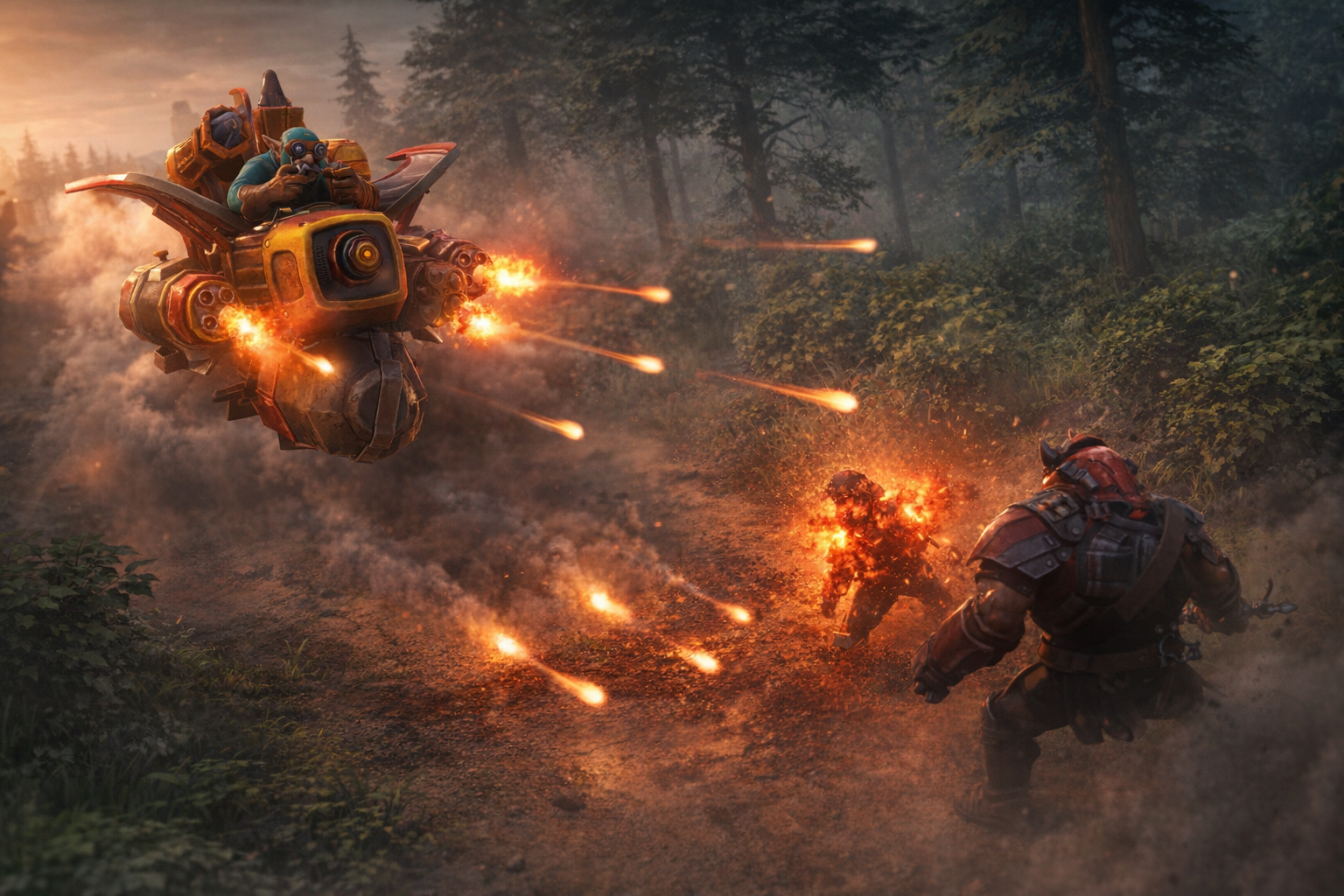
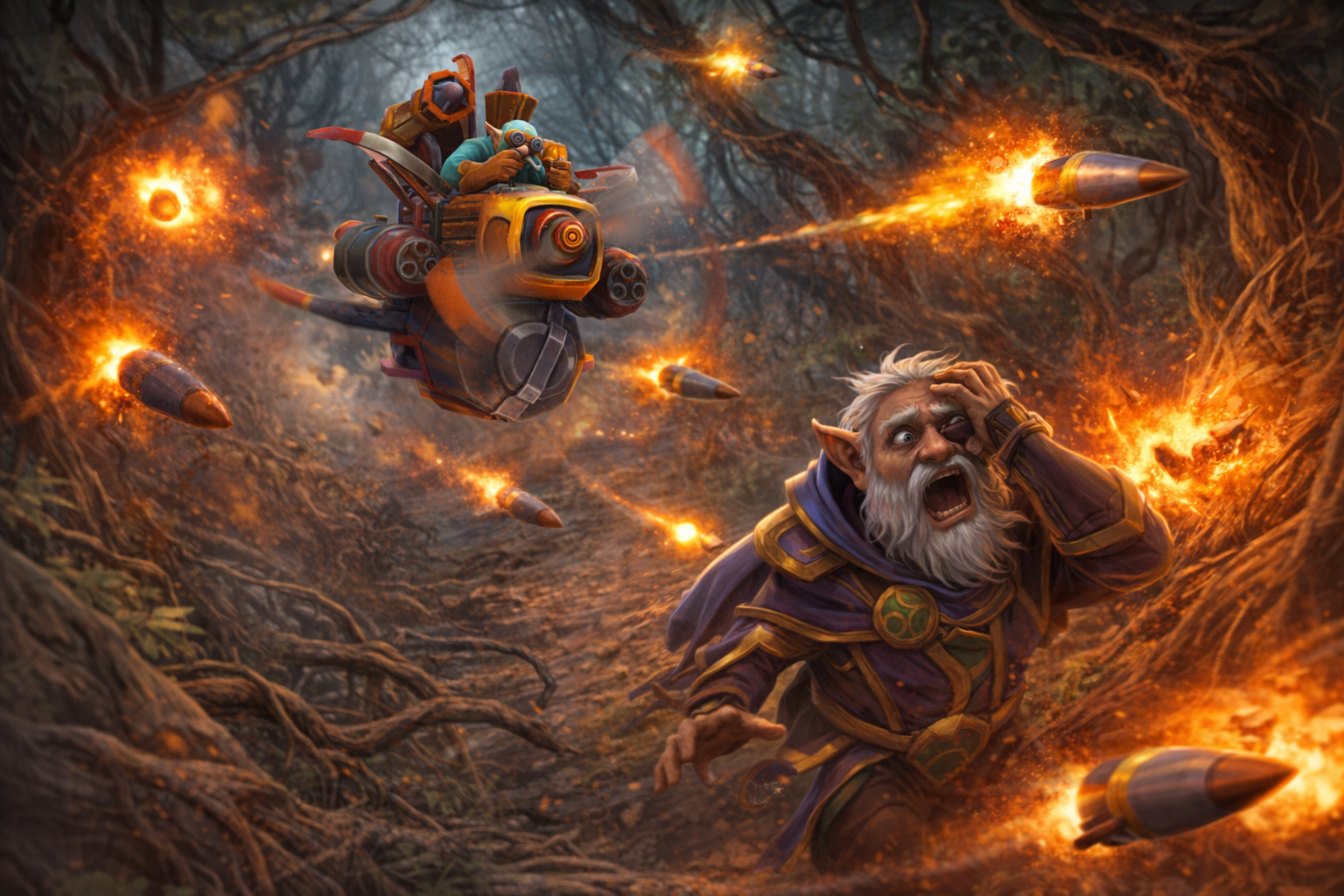
By the end of this, you'll know how to lane Gyrocopter support without feeding for Rocket Barrage, when the Shard timing is actually worth warping your game around, and why trying to become a fourth core usually throws away the best part of the hero.
You’ve seen this lane before. Gyrocopter walks up like he’s about to erase somebody, Barrage starts, and two seconds later he’s tanking both heroes, eating every spell, and waddling back to tower with fifty HP while his carry types a question mark. Then minute 22 hits, the map opens up, and the same Gyro is holding half of a greedy damage item while the enemy cores are already online.
That’s the whole story of support Gyrocopter in one sequence. The hero can make lane feel disgusting, can create real kill windows with very little setup, and can still look completely useless if you misread your role. Support Gyro works when you treat him like an early-tempo specialist with brutal midgame pickoff tools. He falls apart when you cosplay carry from the four or five position.
What Gyro Support Actually Offers
Gyrocopter support exists for one reason: he can turn small positioning mistakes into immediate damage before most lanes are ready to absorb it.
Rocket Barrage is the centerpiece. In a clean isolated trade, it shreds. That makes your lane pattern very different from passive ranged supports that just chip away and reset. Gyro wants short, violent windows where one enemy hero gets separated from the other and suddenly loses most of their HP bar.
Homing Missile gives you threat before the fight really starts. Even when it doesn’t convert into a kill, it forces movement, forces a response, and creates awkward moments where the enemy support has to choose between helping their core or dealing with the missile. Once you get Aghanim’s Shard, that spell becomes the reason people start dying from positions they thought were safe.
Call Down gives you teamfight presence without asking for farm priority. You don’t need to stand there right-clicking like a wannabe carry to contribute. You press your spells into a skirmish, slow an area, add burst, and let actual cores finish the work.
The hero’s weakness is just as obvious. Gyro support has to stand in danger to get full value out of Barrage, and his scaling without farm priority is limited. That means your game plan needs a timer on it. You’re trying to make the first twenty-five minutes miserable for the other team.
The Lane Lives and Dies on Distance Control
Barrage wins trades when you earn the angle
Most bad Gyro support lanes fail for a simple reason: the hero is played like a ranged poker when he’s really an execution support. Barrage damage looks so stupid early that players convince themselves they can just run at people on cooldown. Then they walk into creep waves, dual-hero focus, and counterstuns.
Your first job is isolating a target.
That means using fog, tree lines, creep aggro, and support positioning so Barrage hits the hero you want instead of splitting pressure or dragging you into a bad exchange. If both enemy heroes are standing on top of each other, the lane is asking for patience. If the support drifts away to pull, contests vision alone, or steps up for a ranged creep, that’s your opening.
Gyro support is one of those heroes where half the skill expression is knowing when not to press Q.
Trade your body with a purpose
You are allowed to spend HP aggressively in lane. In a lot of lanes, you should. Gyro’s early spell damage can make HP a resource worth converting. The mistake is spending your body without securing either a kill attempt, a consumable advantage, or control over lane space.
If you walk up, force both enemy heroes to hit you, and only get a couple random right-clicks in return, you’ve donated. If you trade your health to zone the five away from the pull camp, force regen, and set up your core for a favorable creep position, that’s good support play.
This is why Gyro often wants lane consumables and mana sustain early. You are not there to preserve a pristine net worth screen. You are there to create pressure that matters.
Flak Cannon in lane is a luxury point
A lot of players get tempted by Flak because it feels versatile. In support Gyro lane, your first levels usually need to serve one purpose: make your kill combo stronger and more reliable.
That pushes skill points toward Rocket Barrage and Homing Missile. Barrage scales your immediate kill threat. Missile adds catch and forces reactions. Those are the buttons that justify the pick.
A value point in Flak can have a place in certain lanes for wave interaction or ranged harassment patterns, but it’s rarely the reason your lane succeeds. If the lane is volatile, hard-fighting, and decided by who can burst first, extra points in your damage and catch tools do more work.
If you’ve been feeling the Flak cooldown changes in support games, that’s because the spell no longer smooths out your downtime in lane the same way. You feel more committed to your real windows. That’s another reason to stop pretending Gyro support is some kind of all-purpose ranged bully. He spikes hard in specific moments.
Skill Build: Keep It Brutal
For most support Gyro games, the cleanest approach is simple:
prioritize Rocket Barrage early
take Homing Missile and keep investing in it as needed for kill setup
use Flak Cannon sparingly as a utility point rather than a core lane plan
take your ultimate on time
This build does what support Gyro needs most. It maximizes early kill pressure and keeps your threat relevant as fights move from lane skirmishes into small map clashes.
If your lane partner has reliable disable or strong chase, Barrage becomes terrifying. If your lane partner is weak early, you can still use Missile to manufacture pressure and force defensive play. The point is consistency. Your levels should sharpen the hero’s best identity instead of softening him into a little bit of everything.
The Shard Timing Is the Real Decision Point
Why players rush it
Aghanim’s Shard is usually the item that determines whether support Gyro becomes a real problem or just a lane gimmick. It adds reach to your catch, improves your ability to threaten from safer positions, and gives the hero a strong reason to keep fighting as the map opens up.
That’s why so many good Gyro support games revolve around hitting Shard as early as possible. Once you have it, pickoffs become cleaner, follow-up becomes easier, and your contribution stops depending entirely on walking into Barrage range.
That matters because the hero’s biggest gameplay problem is self-exposure. Shard helps solve it.
When to delay it
Rushing Shard every game sounds sexy until your team loses a fight because nobody has Force Staff, Glimmer Cape, or the basic utility item the game is screaming for.
If the enemy lineup jumps one target and deletes them, a save item can win more games than your own extra kill pressure. If your cores need help entering fights, building around that need is the higher-level play. Support Gyro is still a support. That sounds obvious, but plenty of players forget it the second they get a couple early kills.
The clean rule is this: if your team can keep snowballing off your aggression, Shard is premium. If the map is turning reactive and somebody needs to keep allies alive, buy the support item that lets your real win condition function.
Itemization: Build for the Fight You’re Actually Playing
Early items
Gyro support loves regen and mana in lane because his lane identity depends on repeated threat. Cheap sustain lets you take ugly trades and come back ready to go again. Boots matter because spacing is everything on this hero. If you can’t enter and leave fights cleanly, your spell damage turns into feed.
Tranquil Boots often make sense for that reason. They support the hit-and-run style and let you reset after committing your HP in lane. Soul Ring can also fit games where you need frequent spell usage and can manage the health cost.
Midgame utility
This is where players usually ruin the hero.
Force Staff is excellent on Gyro because positioning is your whole life. It lets you fix your own mistakes, save an ally, close a gap for spell follow-up, or escape after a Barrage commitment. Glimmer Cape gives you survivability and save potential in games where magical burst and vision-based targeting matter. Drums can work in tempo lineups that want to keep moving. Mekansm-style team sustain can be valuable if your lineup groups early and fights often.
Lotus Orb, Eul’s Scepter, or Linken’s Sphere-style defensive answers can all be justified in games where specific enemy catch is deciding every engagement, though the exact choice depends on draft and farm.
These aren’t boring consolation prizes. These are the items that keep your side ahead once the lane phase stops being enough.
The greed trap
Damage items on support Gyro have one condition: you are already ahead, the game is flowing through your tempo, and your team does not urgently need utility. Even then, the item has to accelerate your existing advantage instead of delaying a real timing.
Phylactery-style burst can feel great when you’re snowballing. The problem is that many support Gyro players use one good lane as permission to stop supporting. Then the game drags, enemy cores get their items, and your inventory turns into a pile of half-committed greed with no save, no reset, and no answer to initiation.
You do not need to become the fourth core. You need to make the three cores on your team stronger by making the game easier to play.
Midgame: Play Like a Hunter, Not a Frontliner
Once towers start falling and lanes stretch out, Gyro support should shift from lane bully to pickoff enabler.
Missile pressure around side lanes matters. Vision matters more. Your pathing matters a lot more. Charging straight into the first hero you see is how you donate your streak and lose all map control.
Look for fights where somebody else starts and you arrive with layered damage and control. Smoke moves are great for this hero because the first contact is everything. Gyro excels when the enemy is reacting late. He looks terrible when the enemy gets to see him coming and plant their feet.
Your ult should be used to make areas unplayable during skirmishes, tower defenses, Roshan approaches, and retreat paths. You’re not trying to produce cinematic solo kills by yourself in every fight. You’re trying to make movement awkward enough that your team can collapse.
This is also where your own positioning discipline has to improve. Early lane Gyro can survive by brute force and consumables. Midgame Gyro support gets punished hard for lazy entries. Stay near fog. Abuse high grounds. Let sturdier heroes reveal first. Use the threat of your spells before you spend your body.
Late Game: Accept the Clock
Support Gyrocopter has a very real problem after the game drags. Enemy cores get tankier, bkbs and defensive tools shape fights, and your spell burst stops deciding engagements on its own. The answer is not to panic-farm into a fake carry transformation.
Your late-game job is narrower.
Provide catch. Provide utility. Protect an ally when the fight hinges on one jump. Add your spell damage at the start of engagements when it still matters. Punish split heroes when the map gives you a window.
If you enter minute 35 expecting to dominate fights through raw output from a support inventory, you’re asking the hero to be something he rarely becomes. If you spent the early and midgame building a lead, forcing bad fights, and enabling your actual cores, you’ve already done the important work.
That timer is part of the appeal. Gyro support rewards players who understand urgency.
Pub Reality: Why the Hero Wins and Why It Throws
In pubs, support Gyro succeeds because people misposition constantly. Supports wander alone for pulls and wards. Side-lane cores overstep for one creep. Small fights break out everywhere, and Gyro loves turning sloppy spacing into instant punishment.
In the same environment, support Gyro also throws because pubs encourage ego itemization. A few kills on the scoreboard and suddenly the hero forgets his slot, his team’s needs, and the fact that the enemy carry is thrilled to see a squishy support spending gold on luxury.
If you want to gain MMR with the hero, the discipline is straightforward:
Lane to kill, not to posture
Every aggressive move should either secure a favorable trade, force regen, deny a pull, or set up a kill. Empty swagger gets punished.
Treat Shard as a timing, not a religion
Buy it when it sharpens your team’s ability to keep tempo. Delay it when utility keeps the game on your side.
Build to solve problems
If the game calls for save, buy save. If it calls for catch, buy catch. If it calls for personal damage because you’re absurdly far ahead, make sure it ends the game faster.
Respect your expiration date
You are strongest when the map is unstable and people are still vulnerable to your burst. Play with urgency and force the issue before the game turns into a stat check.
Support Gyro is one of those picks that looks stupid right up until it ruins a lane and snowballs a whole side of the map. That doesn’t happen because the hero secretly scales like a carry from position four. It happens because he creates chaos early, cashes that chaos into tempo, and hands the rest of the game to cores who can actually close.