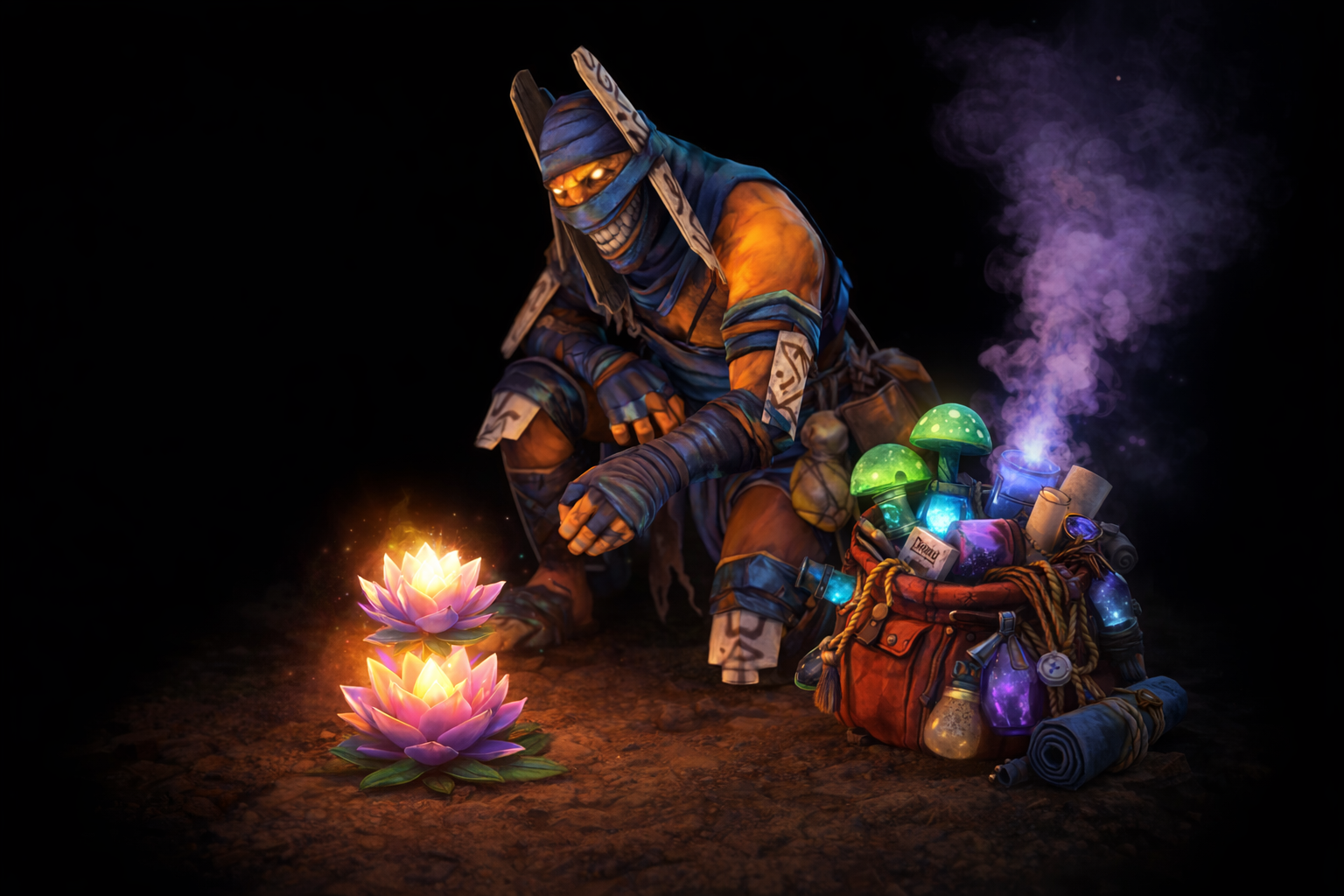
Everyone has lost a fight to inventory nonsense. You ferry yourself through lane with a full six slots, stash a Lotus in the backpack because the lane is finally stable, then a skirmish breaks out at river and you drag it back into your inventory like a civilized person. Six seconds later, your hero is dead, the Lotus is glowing uselessly, and the enemy offlaner is tipping like he discovered fire.
Healing Lotuses look simple. Click pool, get sustain, maybe combine later. The real edge is buried in Dota’s item rules: backpack cooldown, item combining, and the weird little checkbox nobody touches unless they’re doing recipe surgery.
This is one of those mechanics that feels too small to matter until it saves a lane, wins a river fight, or lets you carry one more real item without paying the backpack tax.
The Six-Second Tax Is Real
Backpack cooldown is one of those Dota mechanics you respect in theory and grief yourself with in practice.
Move most active items from backpack to main inventory and they come in disabled for a short window. That rule is there for obvious reasons. Without it, players would turn the backpack into six extra combat slots, swapping in BKB, Blink, Ghost, Force, Dust, Wand, and whatever other nonsense the moment a fight starts.
Consumables get caught in that system too. Healing Lotuses are often treated casually because they are free sustain from the map, but they still occupy inventory space and they still become awkward when carried in the backpack. A Lotus you cannot use for six seconds may as well be a decorative river flower while Slardar is chain-bashing you under your tower.
The pain point shows up constantly:
Your mid wants to hold bottle, wand, boots, raindrops, branches, and a neutral timing item.
Your support is juggling sentries, smoke, blood grenade timings, dust, wand, boots, and lotus sustain.
Your carry has early components, wand, regen, maybe a casual blight stone or wraith band pieces.
Your offlaner wants every small stat item in the world and still expects to pocket sustain.
Lotuses are valuable precisely when slots are under pressure. That makes the backpack interaction more than a cute trick. It changes how greedily you can manage your inventory around the river.
The Lock Combining Trick
The trick uses Lock Combining to dodge the normal backpack cooldown on an upgraded Lotus.
Here’s the clean version:
Right-click your Healing Lotus.
Select Lock Combining.
Put the Lotus into your backpack when you need the slot.
Once you have enough Lotuses for an upgrade, use Unlock Combining while the Lotus is in your backpack or inventory.
The Lotuses combine into the upgraded version and the resulting item is immediately usable.
The key interaction is that you are not simply dragging the same disabled item from backpack to inventory and waiting out the timer. You are allowing the item to combine into a new upgraded Lotus after it has been held locked. That upgrade bypasses the awkward “I just moved this out of backpack” moment.
Dota is full of these little inventory-state quirks. Some are bugs, some are intended consequences of old systems colliding with new ones, and some sit in the gray zone until Valve decides whether they care. This one belongs in your hands as long as it exists because it rewards preparation rather than frantic clicking.
The important part is timing. Lock it before you put it away. If you lazily toss your Lotus into backpack unlocked and then need it during a fight, you are back to eating the cooldown like everyone else. The trick works because you set the item state ahead of time.
Why This Matters More Than It Sounds
A six-second delay is an eternity in early Dota.
Six seconds is enough time for an offlaner to turn level advantage into a kill. It is enough time for a rotation rune fight to go from “barely salvageable” to “mid fed double damage and the enemy supports got both Wisdom runes.” It is enough time for a support to die with two spells uncast because the Lotus that was supposed to bridge the HP gap sat disabled in slot five.
Healing Lotuses are strongest when health and mana margins are thin. That means the fights where you want them are usually messy, low-resource, and decided by one extra spell. A Lotus that gives you enough mana to cast another stun or enough HP to live through a final right-click can be the difference between resetting and feeding a core kill.
The backpack cooldown punishes reaction. Lock Combining rewards planning.
That is the whole reason this mechanic belongs in serious pub play. You are taking a free resource and removing one of its hidden costs. No gold spent, no build changed, no hero pool adjustment. Just cleaner execution.
Lotus Pools Already Reward Discipline
The best players do not treat Lotus pools as background decoration. They path around them, contest them, and time them into lane pressure.
Lotus pools create another objective near the side lanes, especially in the early and mid game. The first few Lotuses often decide how aggressively a lane can trade. Supports who secure them can stretch regen, cores can stay on map longer, and losing lanes can sometimes stabilize without spending extra courier trips on consumables.
As the game runs longer, Lotuses upgrade through the pool system. Great Lotuses and later Greater Lotuses become more relevant as sustain tools, especially when fights stretch around Roshan, Tormentors, high ground sieges, or buyback scraps. The exact value shifts by patch and game state, but the pattern stays the same: free sustain becomes stronger when teams are grouped and resources are strained.
That creates a weird inventory problem. Early Lotuses are nice to have but annoying to hold. Later Lotuses are stronger but your slots are even more contested. By 25 minutes, everyone has real items. By 35, supports are fighting for every slot between detection, save items, mobility, wards, smoke, and maybe a greedy shard timing. By 60, inventory management becomes its own minigame.
The Lock Combining trick lets you bank future sustain without treating your active inventory like a landfill.
The Stacking Fix: Drop It and Pick It Up
Lotuses can also be irritating after they upgrade. Sometimes multiple upgraded Lotuses occupy separate slots instead of stacking cleanly.
The practical fix is simple: drop them on the ground and pick them back up. They should stack properly afterward, up to the item’s stacking limit. You can also drag them onto each other manually when the interface allows it.
That sounds minor until your inventory is full during a long game and two Greater Lotuses are squatting in separate slots like unpaid tenants. Slot economy matters. A support carrying two separated sustain items may be forced to choose between detection and survival. A core may delay picking up a key component because the inventory looks full when it should not be.
Treat stacking as part of the same discipline. If you are already doing the Lock Combining setup, take the extra second outside danger to clean your Lotus stack. Do it near tower, fountain, behind your team, or while waiting for a wave. Do not do it in the river while Night Stalker is missing. Dota punishes cute mechanics performed in stupid places.
The Real Tension: Skill Expression or Interface Cheese?
Every inventory trick in Dota lives in the same argument. Some players love this stuff because the game has always rewarded mechanical literacy beyond spellcasting. Others see it as interface gymnastics that should be automated or removed.
Both instincts come from real Dota experience.
The skill-expression case is straightforward. Dota has never been only about hero control. It is courier usage, backpack timing, tread switching, wand efficiency, smoke discipline, pre-placing items before death, dropping stats before regen, shift-queueing movements, animation abuse, rune control, and a hundred other tiny optimizations. The player who knows the systems should gain something.
The frustration comes from opacity. Lock Combining is not exactly a glamorous mechanic. Many players interact with it only when accidentally buying components that want to assemble into the wrong thing. A Lotus backpack bypass tied to that menu feels like something you learn through osmosis, coaching, or painful experience rather than through normal play.
Dota has always been hostile to players who do not study it. That hostility is part of the game’s identity, for better and worse. The cleanest version of Dota would surface useful rules without sanding off every sharp edge. Until that happens, knowing the weird edges is part of climbing.
The key distinction is that this trick does not require scripting, absurd APM, or unrealistic execution. You right-click an item and toggle a setting before the fight. That is fair game. If you can remember to tread-switch before Arcane Boots or backpack a Wraith Band before using Salve, you can handle this.
Who Benefits Most
Supports gain the most immediate value because their inventories are disasters by design.
A position five can easily want wards, sentries, dust, smoke, wand, boots, and a save item before the game even opens up. Add a Lotus to that and something gets sacrificed. The backpack becomes mandatory, and the six-second penalty becomes a real risk during river movement or defensive rotations.
For supports, the trick lets you carry Lotus value without giving up active utility. You can keep dust ready, hold wards, and still have future sustain available once combined. That matters in games where the enemy has invis threats or where your team needs constant vision around objectives.
Mid players also benefit. Rune fights often involve awkward resource thresholds. A locked Lotus in backpack can become relevant when you are assembling sustain around a timing, especially if your bottle is empty and both supports are too busy feeding side lanes to help. Mid inventory is tight early because small stat items and bottle already crowd the bar.
Offlaners like the trick because they live in ugly trades. A Lotus can let you keep pressuring tower, survive the support rotation, or cast one more spell in the fight around the enemy safe lane. Offlane inventories also fill quickly with bracers, wand, boots, aura components, and lane-specific items.
Carries benefit less often in the first phase of the game because they usually prefer stable farming patterns over constant river brawls, but the value rises in long games. Once upgraded Lotuses enter the picture, a carry can preserve a slot more intelligently while preparing for fights near Roshan or high ground.
When to Actually Use It
Use the trick when all of these conditions are true:
You are carrying Lotuses you do not need immediately.
Your main inventory slots are contested.
You expect to combine them later.
You may need the upgraded Lotus without waiting out backpack cooldown.
That sounds obvious, but the decision matters. If you are low HP in lane and need sustain now, use the Lotus now. If the enemy is missing and you are about to walk through river, maybe keep the usable item in your main inventory rather than getting fancy. If your inventory is open and you are not under pressure, there is no reason to overcomplicate it.
The trick is strongest as a pre-fight setup. Before moving to contest an objective, clean your items. Lock the Lotus if it is going into backpack. Combine when ready. Stack if needed. Then go play Dota with one fewer stupid UI problem waiting to kill you.
This also matters before teleporting. TP rotations often throw you straight into fights with no time for inventory cleanup. If your Lotus plan requires six seconds after arrival, the fight may be decided before your item wakes up. Set it before the TP, especially when rotating toward a tower dive or river clash.
Common Ways to Mess It Up
The first mistake is locking too late. If the item has already moved from backpack to inventory and is disabled, toggling menus will not magically undo your poor timing. The whole point is to avoid creating that disabled state in the first place.
The second mistake is forgetting that locked items stay locked. Dota players love preparing a clever mechanic and then losing value because the preparation remains active five minutes too long. If your Lotuses are sitting locked and you expect them to combine naturally, they will not behave the way you want until you unlock them.
The third mistake is doing inventory maintenance while visible and vulnerable. Dropping upgraded Lotuses to fix stacking is fine in safe spots. Dropping items in contested areas is an invitation for disaster. Enemy players do not need a PhD to click free stuff on the ground.
The fourth mistake is overvaluing the trick. This mechanic saves seconds and slots. It does not justify bad pathing, late rotations, or ignoring Lotus pools for half the game. Good inventory play amplifies good map play. It rarely rescues nonsense.
Pub Impact: Free MMR in the Margins
Most pub games are decided by enormous errors. Someone feeds without buyback. A team hits high ground into five heroes with all spells ready. A carry farms triangle while Roshan dies for free. Compared to that, a Lotus backpack trick sounds tiny.
Tiny edges stack fast in Dota.
A support who secures Lotuses more consistently saves gold on regen and has more health for trades. A mid who uses sustain cleanly survives one gank and keeps tempo. An offlaner who holds a slot open gets aura timing cleaner. A team that arrives to river with resources ready wins the fight before anyone notices the reason.
The best part is how low-cost this is. You do not need to change your draft priorities. You do not need to spam a niche hero. You do not need a perfect lane partner. You only need to respect a free map resource and stop letting the backpack system steal its timing.
In low and mid MMR games, this will win fights because opponents already underestimate Lotus sustain. People chase kills based on visible HP and mana, then get baited by a sudden heal and one extra spell. In higher MMR games, the value comes from slot efficiency and cleaner objective prep. The mechanic scales because inventory pressure never disappears.
Dota rewards players who understand the boring systems. The flashy clip is the turnaround kill. The actual reason it happened may be a Lotus that was usable on frame one instead of disabled in your backpack while your hero died like a courier with boots.
Make It Muscle Memory
Bind the habit to moments you already use.
When you collect a Lotus and your slots are full, decide immediately whether it belongs in the backpack. If it does, lock combining first. When you are walking to an objective, check whether your Lotuses can be unlocked for an instant upgrade. When multiple upgraded Lotuses clutter your inventory, fix the stack in a safe place before the next fight.
That is the whole mechanic. No drama. No secret macro. Just better handling of an item everyone has access to and too many players treat like random lane candy.
The next time you die with a disabled Lotus in your inventory, that death is on you. The game gave you a way around the delay. Use it.