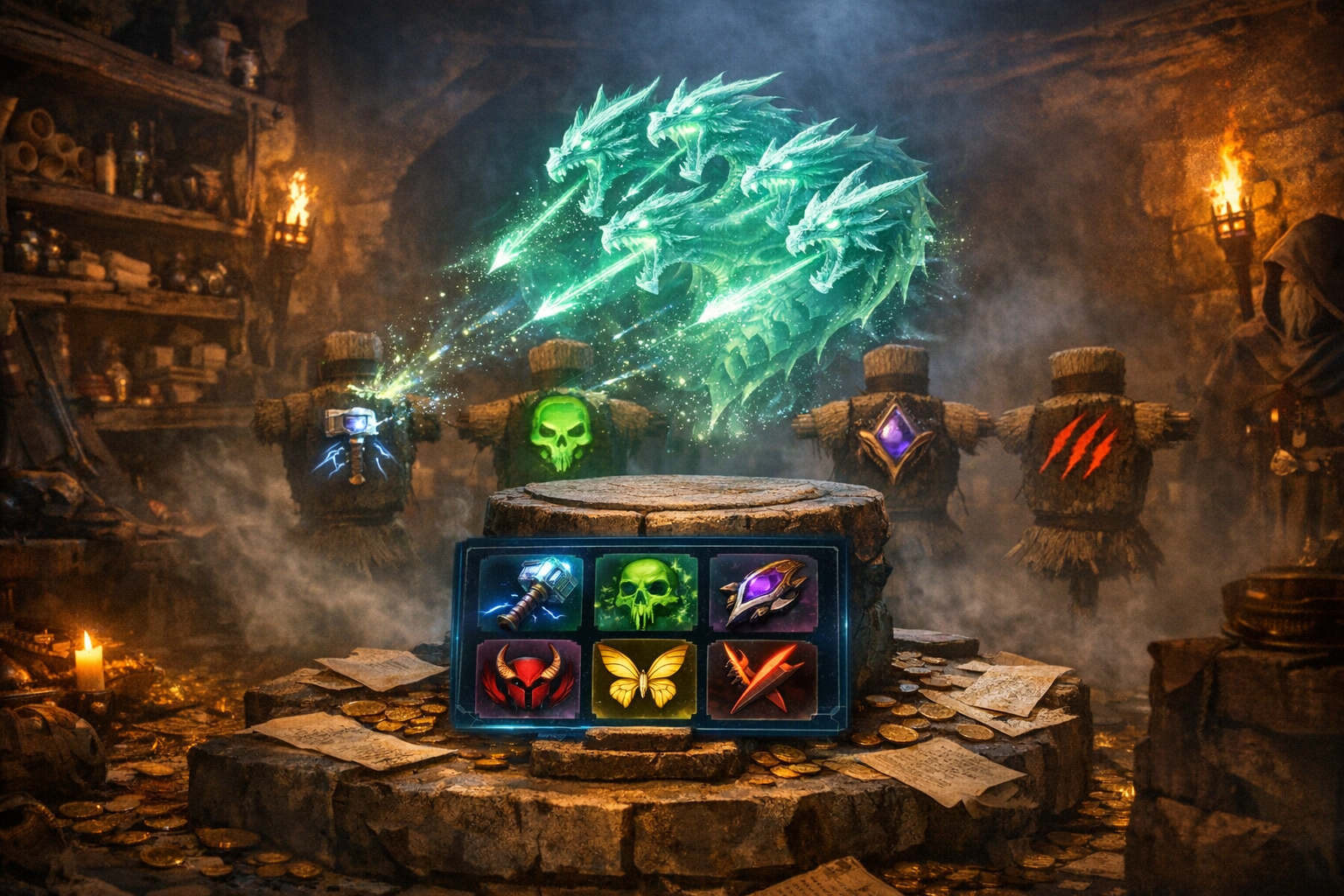
Hydra’s Breath Is Trapping Your Item Build
You’ve seen this game before. Your carry comes out of lane fine, picks up a farming accelerator, then starts stitching together a flashy late-game inventory that looks terrifying in the shop. Hydra’s Breath shows up next to Mjollnir, Parasma, Brooch, maybe Desolator, and for about ten minutes everyone pretends the hero is about to machine-gun an entire team with layered procs. Then the fights happen, the damage lands flatter than expected, and the slot that looked clever turns into dead weight.
If your goal is to gain MMR by tightening one repeatable habit, start here: stop buying Hydra’s Breath as a “combo” item with attack modifiers that it does not spread. Treat item slots as a system. Every pickup should either multiply what your hero already does or solve the thing that stops you from doing it. Hydra’s Breath only passes that test in a narrower set of games than a lot of players want to admit.
The Shop Mirage
Hydra’s Breath is one of those items that invites assumptions. You read the passive, you see extra attacks, and your brain fills in the rest. More arrows, more targets, more on-hit value. That leap makes intuitive sense because Dota has trained players for years to look for chaining interactions, splash abuse, orb synergy, and clever ways to turn one attack into five effects.
That instinct is usually good. It just leads you off a cliff here.
The core mechanical truth is simple: the secondary arrows from Polycephaly are not carrying your other attack modifiers onto those extra targets. If you bought Hydra’s Breath expecting your side hits to behave like full attacks with all your expensive item text attached, your inventory is lying to you.
That misunderstanding matters because the item lives in a price range where every slot has to justify itself against brutally strong alternatives. A luxury item that only looks synergistic is worse than a mediocre item. At least mediocre items are honest.
What Hydra’s Breath Actually Gives You
Extra attacks are not full-value attacks
Hydra’s Breath creates a visual story that is bigger than the real damage story. You attack one target, additional arrows go out, and it feels like your build is fanning across the fight. The problem is that many players mentally file those extra arrows under “my regular attack, but copied.” That’s where the bad purchases start.
Those secondary arrows do not function as a delivery system for your collection of on-hit toys. If your plan revolves around Mjollnir lightning erupting across several heroes, that plan is broken. If your plan revolves around Parasma spreading its effect through the side arrows, that plan is broken. If your plan revolves around Revenant’s Brooch adding its special damage behavior to those extra hits, same problem. Desolator armor corruption on all the splash targets also stays in fantasy land.
Once you remove those imagined interactions, the item needs to be judged for what it really is: a stat-heavy right-click item with extra target coverage that scales mostly off your raw attack damage, attack pattern, and the actual combat context.
Raw damage heroes use it better
That distinction is everything.
A hero who naturally hits hard and values multi-target physical pressure can extract real use from Hydra’s Breath. A hero who needs every arrow to also carry premium item effects usually can’t. The more your late-game build depends on layering modifiers, the worse Hydra’s Breath looks.
That’s why the item can appear solid on heroes who already produce large right-click numbers without needing side-arrow gimmicks. If your damage is fundamentally coming from being a huge statted physical core, extra target pressure has meaning. If your damage is supposed to come from Mjollnir, Brooch, Parasma, Deso and similar effects all piggybacking together, Hydra’s Breath starts eating a slot that should have gone somewhere smarter.
The Fake Synergy Problem
Mjollnir bait
Mjollnir is probably the cleanest example because the fantasy is so seductive. Fast attacks plus chain lightning plus extra arrows sounds like a full-screen pub wipe. In practice, Hydra’s Breath is not turning every side arrow into another lightning machine.
So you end up paying for overlap that doesn’t really exist. You already invested in an item whose value comes from attack speed, farming pace, and proc pressure. Hydra’s Breath doesn’t amplify the proc part in the way many buyers expect, which means the second purchase is dramatically less efficient than it appears during the planning stage.
Parasma and Brooch bait
Parasma and Revenant’s Brooch sit in the same trap category for a different reason. These are the sort of items players buy because they want each hit to matter in a very specific way. Hydra’s Breath invites the idea that you can extend that special hit profile across multiple heroes at once.
You can’t bank on that. The side arrows are not your ticket to mass application of those effects. Once that illusion is gone, you’re looking at an item that asks for huge gold commitment while offering less actual scaling than the inventory screen suggests.
Desolator bait
Desolator has always attracted players who love direct, readable damage conversion. Armor reduction on a priority target is easy to understand and easy to feel. It also creates the same mistake: players see extra arrows and picture the whole enemy team getting softened up at once. That isn’t what you’re buying.
When the extra hits don’t deliver the effect you expected, the item combination stops being a force multiplier and starts being a pile of loosely adjacent concepts.
Why the Slot Hurts More Than the Gold
Dota punishes dead-end itemization harder than a simple net worth calculation suggests.
A bad purchase is never just the gold spent. It’s the BKB timing that got pushed back. It’s the Pike you didn’t buy before the enemy got their next jump tool. It’s the Hex you never completed, so the slippery core got one more round of spells off and the fight snapped in half.
Hydra’s Breath becomes dangerous when it delays the item that actually lets your hero participate in real fights.
That’s why so many builds with the item look fine while you’re farming and then feel awful the moment the map gets tight. Open lanes hide bad item logic. Five-on-five Dota exposes it.
The Better Question: What Stops Your Hero From Hitting?
Before you buy a luxury damage item, ask one practical question: what is currently preventing your hero from dealing sustained damage in a fight?
For a lot of ranged cores, the answer is distance. You need to keep hitting while the enemy closes. That points toward Hurricane Pike far more often than players want to admit. Pike gives you a way to maintain spacing, commit from safer angles, and survive the first wave of contact long enough for your existing damage items to matter.
For other games, the answer is control. A target needs to die before they get spells off, or a mobile core needs to be pinned down long enough for your team to finish the job. That’s where Scythe of Vyse can outclass another damage toy by a mile. Dead heroes take infinite follow-up.
Sometimes the answer is much uglier and much simpler: you’re getting stunned and killed. BKB and Linken’s don’t make inventory screenshots sexy. They win games because alive heroes output damage and dead ones don’t.
Why Sniper Players Keep Throwing With It
Sniper is one of the cleanest pub case studies because the hero tempts greed every single match. You get range, you get confidence, and once you’ve had a few free fights from the backline, every item choice starts drifting toward “more damage, more cute interactions, more screen-wide pressure.”
That works until the enemy draft has actual access.
If the other side has multiple gap closers, Hydra’s Breath is exactly the kind of purchase that flatters your damage chart while sabotaging your ability to stand and hit. You don’t need a prettier attack animation sequence. You need a way to create one more second of space. Pike does that. Defensive slots do that. Raw greed rarely does.
This is where MMR leaks happen. Players look at a game through the lens of ideal uptime, then itemize as if nobody will ever touch them. Real fights are uglier. You get wrapped on, smoked on, blinked on, run at through vision gaps, forced to reposition twice, maybe three times. Every item has to answer that reality.
The Hoodwink Exception Tells You the Rule
Some heroes can produce interactions that make Hydra’s Breath look much better than it does in generic carry theory. Hoodwink is a good example because her attack delivery is already weird in ways that can make item synergies more interesting.
That does not rescue the broad habit of jamming Hydra’s Breath into any ranged physical build and calling it scaling.
Dota is full of hero-specific exceptions. One hero making unusual use of an item says nothing about whether the average player should treat that item as a standard extension of every right-click kit. If anything, exceptions are a warning label. The more an item needs special handling, the less you should autopilot it.
When Hydra’s Breath Is Actually Fine
Tanky lineups can justify it
There are games where the enemy team puts several durable cores in front of you, fights are long, and extra multi-target physical pressure has real value even without modifier spread. In those games, Hydra’s Breath can be reasonable, especially when you already have the freedom to stand your ground and hit.
That last part matters as much as the enemy draft. The item improves when you are already ahead on map control, vision, tempo, or survivability. A winning core with room to attack can cash in on luxury stats far more effectively than a struggling core trying to itemize out of danger.
Ahead-state itemization changes the math
A rich core can buy items that a tied or losing core should never touch. This is one of the oldest truths in Dota and one of the easiest to forget when copying a build from a game that had totally different conditions.
If a carry is already comfortably ahead, has enough protection, and expects long front-to-back fights into durable heroes, Hydra’s Breath can fit. The key is that it’s being bought from a position of solved problems. Range is covered. Survival is covered. Fight access is covered. The item becomes a pressure tool, not a patch for missing fundamentals.
That distinction separates intelligent greed from ranked self-harm.
Specialist Array Logic Still Applies
A useful way to think about Hydra’s Breath is as an upgrade path question. If your hero appreciates earlier stepping-stone attack tools and your game naturally leads toward enhanced multi-target right-clicking, there’s room to consider it. Even then, you should be brutally honest about what the final slot is doing.
Does it increase your actual fight win chance more than utility? Does it let you kill the heroes that matter? Does it survive contact with the enemy draft? If the answer lives mostly in “it should deal more damage on paper,” keep your gold.
Too many item decisions in pubs get made from the inventory screen instead of the fight replay. The replay shows the truth. You either lacked reach, lacked control, lacked survivability, or lacked enough clean damage to finish durable targets. Hydra’s Breath only solves one narrow slice of that list.
Build for the Fight You’re Going to Play
The cleanest way to climb with core itemization is to stop treating every open slot as a chance to be clever. Build the next item that makes your hero functional under pressure. If your hero already has enough damage, buy the thing that guarantees delivery. If your hero needs a way to pin targets, buy control. If the enemy lineup is built around bursting or catching you, solve that problem first.
Hydra’s Breath has a place. The place is smaller than its reputation. It belongs in games where raw right-click spread into durable targets is genuinely valuable and your hero can already stand in the fight long enough to use it. Outside that lane, it’s a trap disguised as scaling.
A lot of MMR gets lost to purchases that feel advanced. The better players usually look boring in the shop. Then the fight starts, and all their items do exactly what the game demanded.