There is always something spawning. You win a fight, shove one wave, start thinking about your next item timing, and the map immediately starts screaming at you again. Someone pings a rune, someone else pings the gate, your support is already walking toward a glow on the ground, and the carry who wanted thirty seconds of silence is now the villain. Modern Dota can feel less like a match unfolding and more like a shift manager handing you the next task.
That feeling matters, because Dota’s best moments have always come from contrast. The five-man smoke after six quiet minutes hits harder than the fifth forced skirmish in a row. The greedy lineup that dodges fights until one disgusting timing can be just as compelling as the draft that runs at you from minute eight. When every game is pushed toward the same rotation rhythm, the action loses some of its bite.
The Map Has Become a Calendar
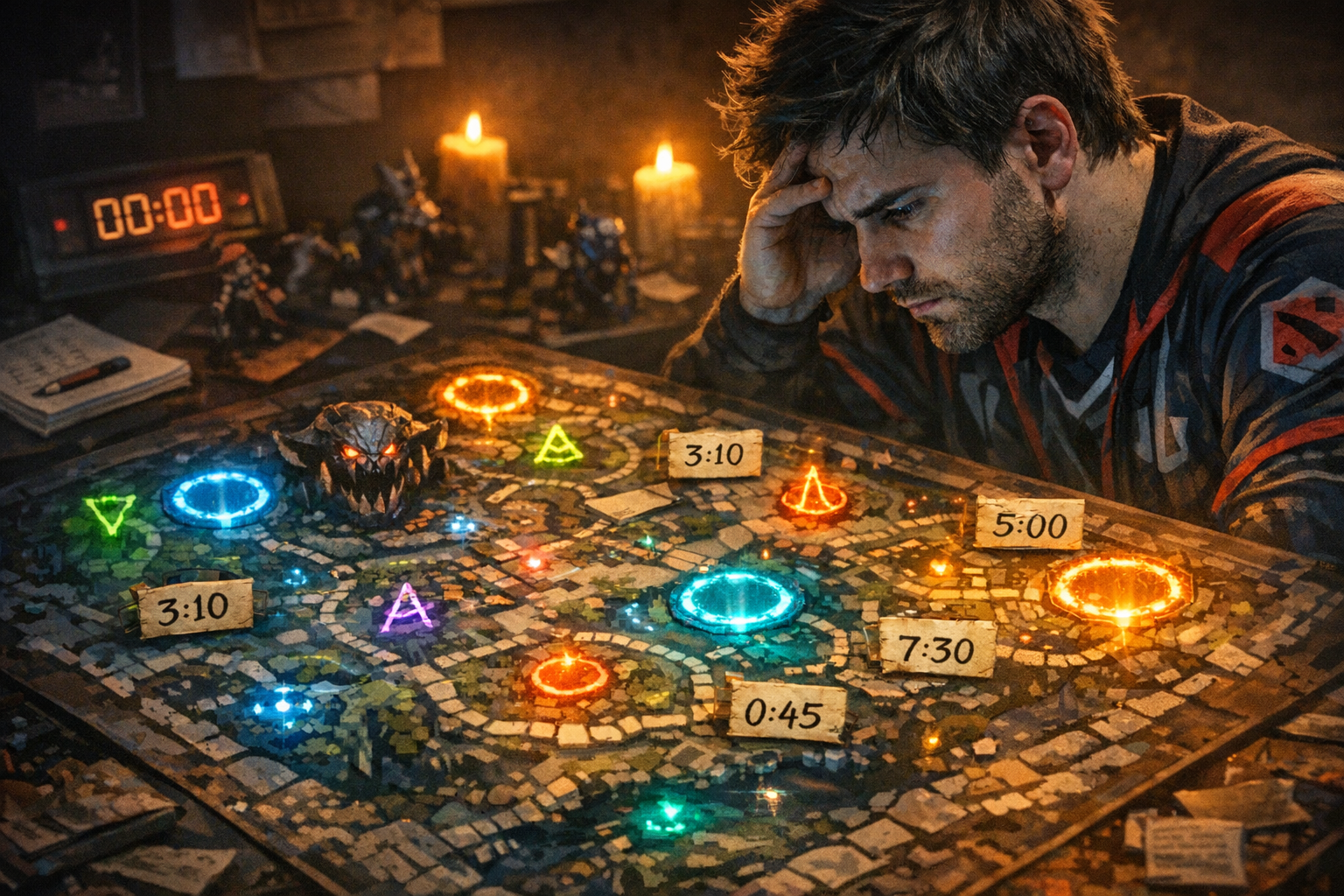
Dota has always had timers. Runes, Roshan, creep waves, neutral items, catapults, buybacks, glyphs, day and night: the game has never been pure sandbox chaos. Good players have always lived by the clock.
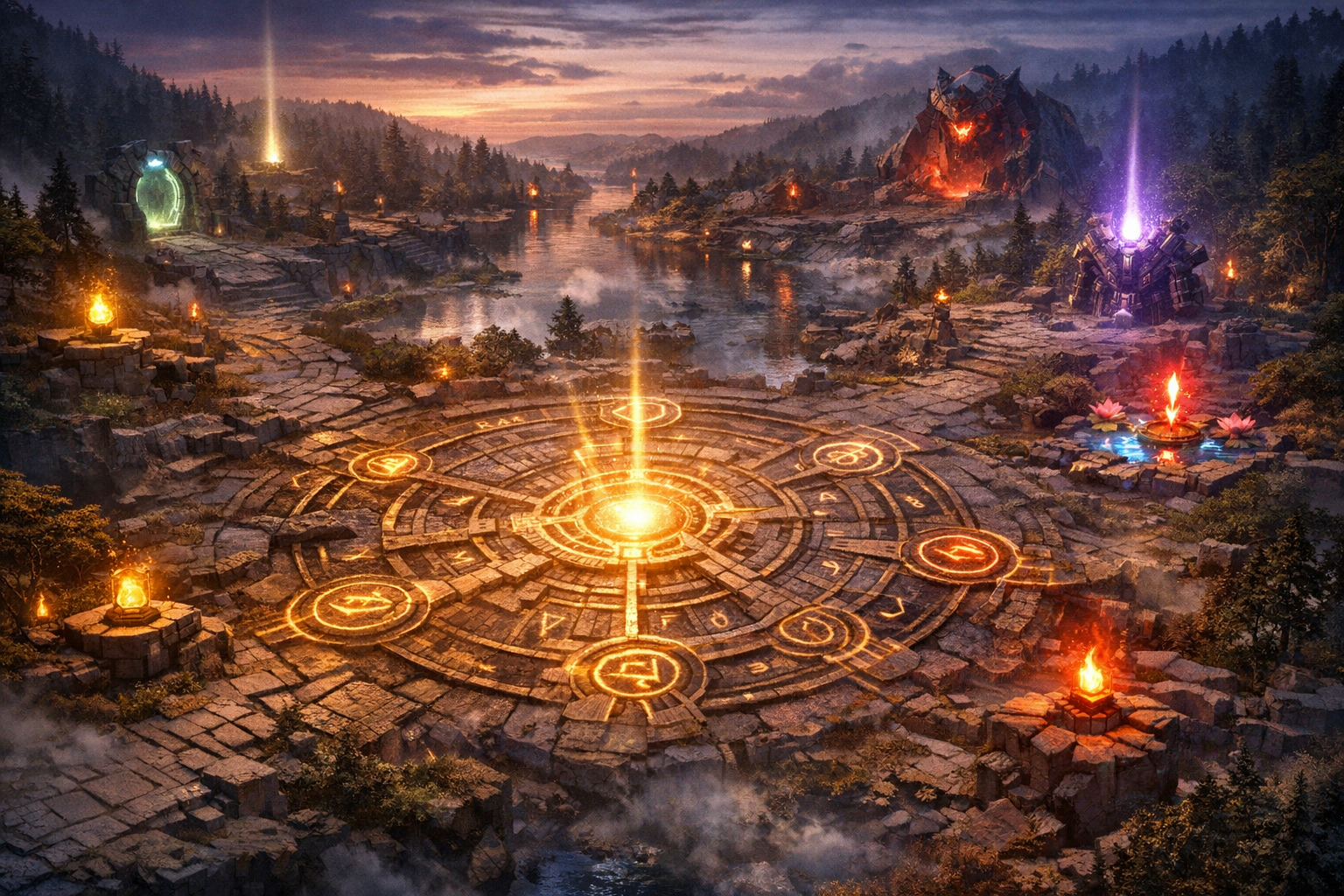
The difference now is density. The modern map asks you to care about more recurring points of interest than ever before. Power runes still shape mid and support movement. Bounty runes still reward map presence. Wisdom runes pull supports toward the edges. Lotus pools create lane-adjacent errands. Tormentors offer a team reward that often demands coordination. Roshan’s position and access routes are tied into the expanded map. Twin Gates turn long rotations into sudden collapses.
None of these systems are individually absurd. Many are good ideas in isolation. Wisdom runes help supports avoid becoming furniture. Tormentors give teams another way to convert map control. Gates create wild side-lane interactions that old Dota simply could not produce.
The problem is the combined texture. The map constantly produces appointment gaming. You are rarely asking, over a clean stretch of time, what the next strategic shape of the game should be. You are often asking who can arrive first to the next scheduled reward without griefing lane equilibrium, vision, or item progress.
That is still decision-making. It can even be high-skill decision-making. But rushed tactical sorting has started to crowd out longer strategic planning.
Action Means More Than Spells Flying
A quiet minute in Dota can be loaded. A carry showing on the wrong wave can reveal the entire map. A support placing a ward without being seen can make the next smoke lethal. A mid hero hiding for twenty seconds can force three enemies to play like cowards. A split pusher hitting a tower while the rest of the team threatens Roshan can create more pressure than a sloppy river brawl.
Spectacle is easy to recognize. Ten heroes throwing ultimates around a pit looks like Dota. Psychological pressure often looks like nothing until the trap closes.
Older styles of Dota gave more room for that pressure to breathe. You could see drafts pull games into different shapes. Some lineups wanted to dodge, cut waves, delay, and hit a terrifying item window. Others wanted to claim the enemy jungle and turn every ward into a death sentence. A tempo draft and a greed draft could disagree about what game was being played.
Modern objective density narrows that disagreement. Even greedy lineups get dragged toward the next spawn. Even aggressive lineups are rewarded for following the same route markers as everyone else. The draft still matters enormously, but the map has stronger opinions now.
There is a musical problem here. If every section is the drop, the drop stops feeling like a drop. Dota needs space before impact. The pause before a high-ground siege, the fake calm before a smoke wrap, the farming pattern that tells you a BKB is thirty seconds away: those moments give violence its shape.
The Real Fear: Returning to Chokehold Dota
Any argument for fewer forced fights runs straight into a legitimate fear: slow Dota can become miserable when the optimal play is to take everything and risk nothing.
The clearest recent memory is the controlled strangulation style around TI11. Tundra were brilliant at turning small advantages into map suffocation. They did not need to flip games through reckless initiations. They squeezed space, denied farm, protected their own timings, and made opponents play from a shrinking box. That kind of Dota is strategically impressive and, for many viewers, brutally dry when it becomes the default.
So the answer cannot be a blind purge of objectives. Remove too many reasons to fight and the best teams may simply stop giving opponents openings. If farming safely and choking vision becomes the highest-percentage play every game, pub players will copy the worst version of it: five heroes hitting neutrals while nobody wants to be the idiot who walks uphill.
Dota needs friction. The map should create conflicts. The question is whether those conflicts should feel like external alarms or consequences of player pressure.
A good objective system should reward teams for already shaping the map. A weaker one summons everyone to a location because the clock says so.
Timers Should Give Way to Triggers
The most interesting direction is making objectives respond more to game state.
Roshan already feels more dynamic than a simple neutral boss because access, vision, and side control matter so much. That idea could go further across the map. Imagine more rewards tied to structural progress, lane pressure, or territory held, rather than fixed intervals. A team that takes towers and controls waves could unlock opportunities because it earned the map, while a team trapped in base would have fewer free errands to bail itself out.
Trigger-based objectives create stories. A tower falling changes what is available. A team controlling an area over time creates a claim. A reward that accumulates and can be taken at a chosen moment asks whether you cash out now or defend it longer. These patterns make players argue with the map instead of obeying it.
Scheduled objectives have one major strength: clarity. Everyone knows when to move. That helps pubs, casters, spectators, and supports who already have too much mental load. The downside is sameness. Once the rhythm is solved, the game starts feeling pre-scripted even when the heroes are different.
Trigger-based systems are messier. They risk being abused. They create edge cases and weird incentives. They also make Dota feel more authored by the ten players in the server.
Map Pressure Needs Better Rewards
Dota has always rewarded map pressure, but modern recurring rewards can dilute the value of subtler pressure. If the best move is regularly to gather around a scheduled point, split pushing and creep manipulation lose some of their threat unless they directly connect to that objective.
Lane control should matter beyond giving you a safer walk to the next glow. If you force two heroes top, that should open meaningful options elsewhere. If your illusion hero keeps waves shoved, the enemy should feel their map collapsing. If your offlaner drags attention for a full minute without dying, the team should gain something more interesting than a slightly cleaner route to the next timer.
This is where older Dota instincts still feel powerful. Cutting waves before Roshan. Showing a fake hero to bait a smoke. Holding a creep wave outside tower range so the enemy carry has to choose between farm and safety. These plays do not need cinematic animation. They make the game feel like Dota because they turn information into pressure.
Modern design should protect that language. The more the map rewards direct attendance, the more players learn to ignore indirect pressure. That is a loss.
Pubs Feel the Worst Version of the Treadmill
At high levels, objective density creates coordinated rotations. In pubs, it often creates guilt.
Your mid wants the rune covered. Your offlaner wants help securing the lane reward. Your support wants the wisdom rune. Someone wants Tormentor. Someone wants to smoke because everyone is already standing near each other. Your carry wants the triangle stacked and the dangerous lane shoved, but the team chat has decided that missing the next objective means lacking map awareness.
The result is a strange mix of constant activity and constant inefficiency. Heroes wander. Supports abandon strong lane states to chase distant rewards. Cores show up to fights before key items because the clock created social pressure. Teams group too early, then fail to farm the giant map they supposedly control.
That is why the response of, pubs are mostly jungle farming anyway, misses the texture. Yes, plenty of games still involve cores vacuuming camps while supports suffer. Modern Dota has a huge map and farming remains a massive part of winning. The complaint is about interruption and priority, not raw combat uptime. Even when nobody is fighting, the game can feel like it is nagging you toward the next mandatory stop.
For average matchmaking, fewer scheduled obligations could make decisions clearer. A support would have more room to decide between warding aggressively, protecting a core, stacking, breaking a smoke, or setting up a kill. A core could make a more honest call about whether joining a move advances their timing or delays the entire win condition. Bad teams would still make bad choices. At least the choices would belong to the players more often.
Drafts Should Be Allowed to Disagree
A healthy Dota meta lets drafts create radically different tempos.
A Medusa lineup should be able to drag the match into an economic war if it survives the early map. A Puck plus Tusk style lineup should be able to turn the first real night phase into a horror movie. A Nature’s Prophet or Beastmaster draft should make the enemy feel pulled apart by lanes and summons. A late-game illusion strategy should change how both teams value waves, vision, and cooldowns.
The best patches allow those identities to clash. The aggressive team tries to break the map before greed becomes unbeatable. The scaling team dodges, trades, and chooses one clean stand. The split-push lineup refuses fair fights until the enemy loses patience. That variety makes Dota endlessly watchable and playable.
When objectives constantly pull both teams to shared locations, drafts still differ in execution, but they converge in route. Go here. Fight now. Reset. Go there. Fight again. The heroes change, the calendar remains.
Valve has spent years making Dota more active, more recoverable, and less punishing. Many of those changes improved the game. Supports are richer and more fun. Comebacks are more plausible. More heroes get to participate before the match is functionally over. The cost is that long-term decisions can feel lighter when resources are plentiful and recovery points keep appearing.
A slight reduction in free resources and forced rotations would make preparation matter more. Positioning would matter more. Vision would matter more. Wasting a smoke, showing on the wrong wave, or missing a key timing would sting harder. Dota becomes sharper when mistakes carry weight.
The Better Pace Is Uneven
The goal should be uneven pacing. Some games should explode early. Some should simmer. Some should be ugly farm wars where one smoke decides twenty minutes of setup. Some should be tower-trading chaos where neither team ever gets the clean fight it wants.
That variety makes the fast games feel fast. It makes the slow games feel tense rather than empty. It gives drafts a chance to impose personality on the match instead of merely choosing the best tools for the same objective circuit.
Dota does not need to become a museum piece full of seventy-minute handshakes and terrified carries. It needs fewer moments where the map feels like it is playing captain. Let teams create the reason to fight. Let silence become threatening again. The next great teamfight will hit harder when the game gives it room to arrive.