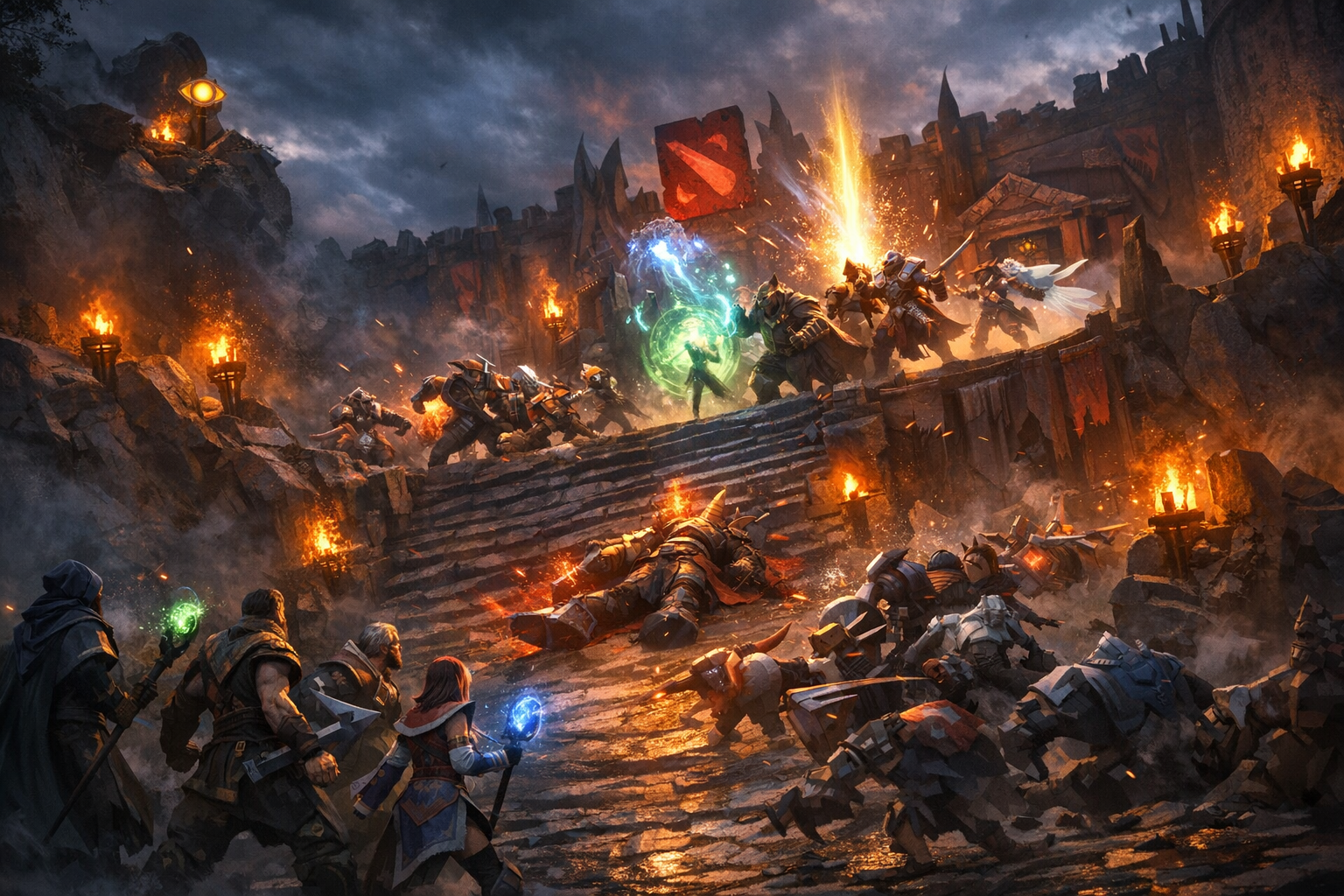
You’ve lived this game. Your team crushes lanes, takes the outer towers, owns the map for fifteen straight minutes, and then everything grinds to a halt at the enemy base. Somebody walks up the ramp, gets chain-stunned under tower, buybacks start flying, and suddenly the team that spent the whole mid game losing is one fight away from stealing it. Then chat fills with the usual diagnosis: high ground is broken.
That frustration is real. It just points at the wrong culprit. In most pub games, turtling doesn’t look strong because base defense is unbeatable. It looks strong because the team ahead gets impatient, drafts no real building hitter, refuses to play for Aegis windows, and tries to force a clean ending with a lead that only matters on the scoreboard.
High Ground Is Supposed to Be Hard
Dota has always needed a part of the map where the losing team can finally plant its feet. If every lane win converted directly into a lane of barracks, the game would flatten into a snowball simulator. Base defense creates a phase where execution matters more than the graph. Your advantage has to become something concrete: vision control, buyback edge, Aegis, lane pressure, item timing, and a formation that can survive the first jump.
That design produces better games when it works. The problem in pubs is that players often treat a mid-game lead like permission to end whenever they feel like it. Dota doesn’t care how good your first twenty minutes looked. It cares whether your lineup can walk up a ramp into compressed enemy spell usage and live through the answer.
The base itself multiplies every defender’s value. Towers provide a secure anchor point. The ramp denies vision. Defenders get shorter travel distance from fountain. Initiators know exactly where the attackers have to stand. AoE control becomes easier to place because the attacking team has fewer angles and less room to spread. If your lineup needs open ground, flanks, or long chases to win fights, the enemy base strips those strengths away.
That doesn’t mean the game is rewarding passive play more than it should. It means Dota still distinguishes between winning the map and ending the game.
The Map Is Full of Money, and That Changes Everything
One reason high ground feels worse in average pubs is simple: there is a lot of gold available on the map. When a losing team turtles correctly, it isn’t surviving on scraps the way older versions of Dota sometimes forced you to. Waves still come to you. Safer farm still exists. Dead space for the winning team becomes real if they stop playing the map with discipline.
That creates a weird emotional trap. You look at the game and feel that your early lead has lost value. What actually happened is that your team stopped converting map control into an expanding resource gap. If the enemy is pinned inside base and the net worth lead stalls, that’s not evidence that turtling is overpowered. That’s evidence that the winning side stopped squeezing.
The right punishment for a team stuck on high ground is not one reckless siege after another. It’s starvation. You hold their entrances, cut the lanes before they reach tower, take every safe camp on your side and the dangerous farm on theirs, secure Roshan access, and force them to burn spells just to touch a wave. The lead grows slowly, which feels boring if all you want is the throne, but boring Dota is often winning Dota.
Pubs hate this because patience is a skill, and it’s a skill most teams stop using the second they see Tier 3s. Plenty of players would rather flip one ugly base dive than spend six minutes widening the game until the enemy lineup can’t function outside fountain range.
Most Teams Don’t Actually Have a High-Ground Lineup
Hitting buildings is a specialist job
A lot of drafts win fights and still can’t end. That’s a massive part of the disconnect.
You need someone who can physically occupy space near the tower and threaten the building without instantly dying for it. That hero doesn’t have to be immortal. The point is that when the enemy commits onto that frontliner, they run into a bad fight. Heroes that naturally stand their ground and keep hitting are priceless here because they turn the siege into a test of defender discipline.
If your carry wants to poke once and back off every three seconds, you don’t really have a high-ground hitter. If your most farmed hero needs perfect positioning and zero commitment to function, you don’t really have a high-ground hitter. If your whole team is built around catching heroes in open map skirmishes, your lineup may be excellent at going 20-8 and terrible at taking one lane of barracks.
Somebody has to punish the jump
The second ingredient is protection. The frontline siege hero only works if the enemy gets punished for engaging on him. Reliable area control matters here more than flashy burst. Stuns, displacement, resets, and counter-initiation are what let you hit a Tier 3 without turning every attempt into a feeding contest.
This is why some games feel impossible to close even with a lead. Your draft can be richer, stronger, and more active, but if nobody can stand on the staircase and nobody can cover that hero when the enemy bites, your advantage has no delivery mechanism.
Siege is a lineup check as much as a net worth check
Players often talk about high ground as if it’s one universal challenge. It isn’t. Different drafts are solving different equations. A team with natural tower damage, a durable frontliner, and huge counter-initiation asks one set of questions. A pickoff lineup with limited structural damage asks another. One can threaten barracks from parity. The other may need Aegis, buyback superiority, and a major item edge before the push is even reasonable.
That gap is where a lot of pub frustration comes from. People judge the siege by the lead they have, not by the tools they drafted.
Aegis Isn’t Luxury, It’s Permission
If you watch strong Dota, one pattern shows up constantly: teams rarely treat high ground like an all-purpose objective they can take whenever they happen to be ahead. They use Aegis as the license to force the issue.
That approach survives every patch because it respects what high ground does to the game state. The defenders have one clean plan. Blow up the first hero who steps up. Aegis weakens that plan immediately. It lets the attacker take a bad first death without losing the whole siege. It forces the defense to spend key spells for incomplete value. It creates a second phase to the fight after the first commitment is already gone.
Without Aegis, plenty of pushes rely on every attacker playing perfectly for ten seconds in the most constrained part of the map. That’s a pub fantasy. With Aegis, the margin for error gets wider, and Dota is often decided by who can widen the margin for error before the decisive fight starts.
There’s a reason the clean sequence feels so much better than random sieging:
Control Roshan
Roshan matters because it ties map control to base pressure. If you own the area, the enemy has to either contest from a weaker map position or give you the one objective that makes high ground sane.
Build the lead while lanes stay shoved
Aegis by itself is not a miracle button. You still want the side lanes in good shape, enemy outer resources squeezed out, and your item progression moving. The strongest siege windows come when the enemy is already suffocating and Roshan turns that pressure into a forced exam.
Force a response, then reset if needed
A failed high-ground attempt becomes disastrous when the winning team treats every push as all-in. Good sieges have an exit. If the enemy expends buybacks or major cooldowns and the lane still stands, you back out, keep control, and repeat later from an even stronger position. A barracks isn’t the only prize. Buybacks, cooldowns, and map access are part of the same transaction.
Why 4k Pubs Make This Feel Worse Than It Is
Average games punish impatience much harder than professional ones because coordination falls off the second a siege gets messy.
In organized Dota, the team knows who hits buildings, who stands behind that hero, who breaks smokes, who saves buyback, and when the call is over. In pubs, one player is hitting tower, one is farming the nearest camp during the siege, one is fishing for a support kill behind the base, and one has already mentally committed to diving fountain if the Tier 3 drops. The defense only needs a few attackers to desync for the whole push to collapse.
That makes base defense look stronger than it is. A lot of these wipes are self-inflicted. The team ahead loses formation. Heroes walk onto different timings. Defensive spell usage gets no respect. Somebody decides the enemy looked scared, which is usually the signal for the dumbest possible move.
Another pub-specific issue is greed distribution. The winning side often has a lead, but the gold is sitting on the wrong heroes for a siege. Maybe your pickoff mid is huge while the building hitter is underfarmed. Maybe your offlaner owns the map for twenty minutes and then has to frontline without enough durability to absorb the base jump. Maybe all the farm went into heroes who kill people quickly but can’t touch structures safely. Net worth is not interchangeable once high ground starts.
A 10k lead can feel fake if the gold sits on heroes who don’t convert it into objective pressure.
The Real Punishment for Turtling Is Map Choke
If the enemy truly turtles, your answer is to treat the whole map as the objective.
You don’t need to walk uphill every minute to prove you’re ahead. Keep lanes pushed so their base defense starts from a worse state. Ward the exits. Catch the hero who gets impatient and shows for one extra wave. Farm the dangerous areas they can’t reach. Occupy the zones around Roshan. Force support movement to become expensive and risky. Make every smoke they send out feel desperate.
This is how turtling becomes bad. The team inside base should be paying a long tax for refusing to leave. If they can sit there and still keep up, the map is being misplayed by the team ahead.
That long choke also solves the biggest pub problem: it creates simpler fights. Open-map skirmishes around entrances, outposts, and jungle routes are easier to execute than a clean base breach. You get pickoffs, force buybacks, or win a fight far enough from fountain that the next push has fewer variables.
One lane down changes the geometry
Once a lane of barracks falls, the game often opens up dramatically. Permanent pressure in that lane creates information and drags defenders into repetitive chores. That’s why the first lane matters so much more than players sometimes admit. It changes the whole map from a sealed base into a structure with a leak.
At that point, smoking through the broken lane with all five heroes becomes much scarier for the defending side. Their movement options shrink, the wave tells on them, and a single pick can turn into an immediate numbers advantage at the base entrance.
That doesn’t mean every team can force this cleanly. It means the payoff for disciplined first-lane execution is enormous.
Should the Game Make High Ground Easier?
There’s a fair question buried under the frustration. Even if impatient pub teams misplay sieges, should the game lower the defensive advantage a bit so more leads actually close?
That change comes with a real cost. Easier high ground would make lanes and early map wins snowball harder. Plenty of games would stop feeling competitive long before they actually end. Dota needs room for the losing team to mount a coherent defense, draft for late scaling, and exploit overconfidence from the team ahead. Remove too much of that and you lose one of the few things that separates Dota from games where the first clean lead decides everything.
The healthier direction lives in better incentives and cleaner execution windows, not turning Tier 3s into formalities. Teams should still need a plan. Aegis should still matter. Drafts should still have to answer the question of who walks up the hill first.
Pub players usually want the game to recognize that they won the early and mid game. Dota already recognizes it. It gives you the whole map, Roshan access, safer farm patterns, and control over when the next important fight happens. What it doesn’t give you is permission to skip the final exam because you aced the first two sections.
If high ground feels impossible in your games, start with the uglier truth. Your team probably isn’t losing to turtle strats. Your team is walking uphill without the lineup, the map state, or the patience to make the push honest.